In this guide
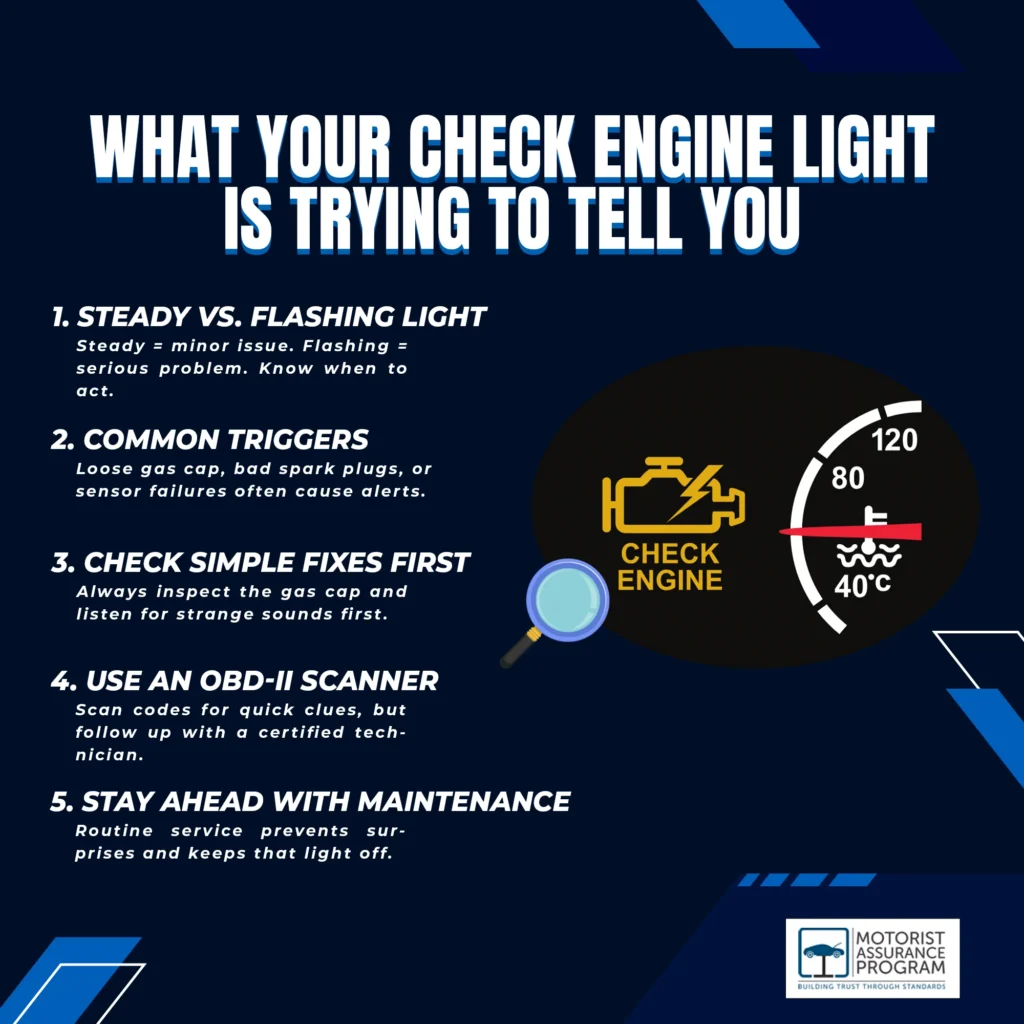
Your heart sinks as you notice that dreaded orange light on your dashboard isn’t just glowing steadily—it’s flashing. A check engine blinking light is one of the most serious warnings your vehicle can give you, and understanding what it means could save you from catastrophic engine damage and thousands of dollars in repair costs. Unlike a solid check engine light that indicates a problem you should address soon, a blinking or flashing check engine light demands immediate attention because it signals that your engine is experiencing severe misfires that could damage your catalytic converter within minutes.
In this comprehensive guide, we’ll dive deep into everything you need to know about a flashing check engine light, from the most common causes to step-by-step troubleshooting procedures. Whether you’re dealing with this issue right now or want to be prepared for the future, this article will equip you with the knowledge to handle this critical situation safely and effectively.
Understanding the Check Engine Blinking Warning System
The check engine light, also known as the malfunction indicator lamp (MIL), is part of your vehicle’s onboard diagnostics system (OBD-II). Modern vehicles manufactured after 1996 in the United States are equipped with sophisticated computer systems that constantly monitor dozens of sensors throughout the engine and emissions systems. When these computers detect a problem, they illuminate the check engine light and store a diagnostic trouble code (DTC) in the vehicle’s memory.
A blinking check engine light specifically indicates that your engine is misfiring severely enough to send unburned fuel into the exhaust system. This unburned fuel can reach the catalytic converter, which operates at extremely high temperatures (typically between 750 and 1,000 degrees Fahrenheit during normal operation). When raw fuel enters the catalytic converter, it ignites and causes the temperature to spike dramatically, potentially reaching levels that can melt the ceramic honeycomb structure inside the converter. A damaged catalytic converter can cost anywhere from $1,000 to $3,500 to replace, depending on your vehicle make and model.
The flashing pattern itself is standardized across most vehicles—the light typically blinks at a rate of approximately once per second. This distinctive pattern is intentionally different from a solid light to grab your attention and communicate the urgency of the situation. Some vehicles may also reduce engine power automatically when a severe misfire is detected, a safety feature designed to protect the catalytic converter and other components from damage.
Most Common Causes of a Blinking Check Engine Light
Understanding why your check engine light is blinking requires knowledge of the engine’s combustion process. For an engine to run properly, it needs the right mixture of air and fuel, delivered at the correct time, with a strong spark to ignite the mixture. When any of these elements fail, the engine misfires. Here are the most frequent culprits behind a flashing check engine light:
Ignition System Failures
The ignition system is responsible for creating the spark that ignites the air-fuel mixture in your engine’s cylinders. When ignition components fail, they’re among the most common causes of engine misfires. Spark plugs are the frontline soldiers of the ignition system, and they wear out over time. Most manufacturers recommend replacing spark plugs every 30,000 to 100,000 miles, depending on the plug type (copper, platinum, or iridium). Worn spark plugs develop gaps that are too wide, preventing them from generating a strong enough spark to reliably ignite the fuel mixture.
Ignition coils convert the battery’s low voltage into the thousands of volts needed to create a spark. Modern vehicles typically use a coil-on-plug design, where each cylinder has its own ignition coil mounted directly on top of the spark plug. These coils can fail due to heat stress, vibration, or electrical issues. When an ignition coil fails, the affected cylinder stops firing, causing a noticeable misfire. Symptoms often include rough idling, reduced power, and poor fuel economy in addition to the blinking check engine light.
Spark plug wires (on vehicles that use them) can deteriorate over time, developing cracks in their insulation that allow electricity to arc to the engine block instead of reaching the spark plug. This condition is called “arcing” and becomes more noticeable in humid weather or when the engine is cold. If you suspect spark plug wire problems, you can sometimes see the arcing as blue flashes under the hood in darkness.
Fuel System Problems
Your engine’s fuel system must deliver precisely metered amounts of gasoline to each cylinder for proper combustion. When fuel delivery fails, misfires occur. Fuel injectors are electromechanical valves that spray atomized fuel into the intake manifold or directly into the combustion chamber (in direct injection engines). These injectors can become clogged with carbon deposits, varnish, and other contaminants found in gasoline, especially if you frequently use low-quality fuel or let your vehicle sit unused for extended periods.
A clogged fuel injector sprays an insufficient amount of fuel or creates a poor spray pattern, resulting in a lean air-fuel mixture in that cylinder. The lean mixture may not ignite properly or may burn incompletely, causing a misfire. Professional fuel injector cleaning services use specialized equipment to flush cleaning solution through the injectors, while fuel system cleaner additives added to your gas tank can help prevent buildup if used regularly.
The fuel pump delivers gasoline from your tank to the engine under pressure. Most modern fuel injection systems require fuel pressure between 30 and 80 PSI, depending on the vehicle. When a fuel pump begins to fail, it may not maintain adequate pressure, especially under high-load conditions like acceleration or driving uphill. Insufficient fuel pressure affects all cylinders, often causing multiple misfires simultaneously and triggering the blinking check engine light. You might also notice symptoms like difficulty starting, engine stalling, or a whining noise from the fuel tank area.
Fuel pressure regulators maintain consistent fuel pressure by returning excess fuel to the tank. A faulty regulator can cause pressure that’s too high (causing rich conditions and rough running) or too low (causing lean conditions and misfires). Testing fuel pressure requires a fuel pressure gauge connected to the fuel rail test port, and readings should be compared to manufacturer specifications.
Air Intake and Vacuum System Issues
Your engine’s computer calculates the correct air-fuel mixture based on data from the mass airflow sensor (MAF) or manifold absolute pressure (MAP) sensor. Any air leaks or sensor problems can throw off these calculations. Vacuum leaks occur when outside air enters the intake manifold through cracked hoses, deteriorated gaskets, or loose connections. This unmetered air leans out the air-fuel mixture, potentially causing misfires, especially at idle and low engine speeds.
Common vacuum leak sources include intake manifold gaskets, brake booster hoses, positive crankcase ventilation (PCV) valve hoses, and vacuum-operated emission control components. You can sometimes hear vacuum leaks as a hissing sound when the engine is running. Professional technicians use smoke machines to pressurize the intake system with visible smoke, making even small leaks easy to spot. DIY detection methods include carefully spraying carburetor cleaner or brake cleaner around suspected leak points while the engine idles—if the engine speed changes, you’ve found a leak.
Mass airflow sensors measure the amount of air entering the engine and can become contaminated with oil, dirt, and debris. A dirty or failing MAF sensor sends incorrect data to the engine computer, resulting in improper fuel metering. Symptoms include rough idling, hesitation during acceleration, and decreased fuel economy. MAF sensor cleaning products are available and can restore proper function in some cases, though severely damaged sensors require replacement.
Mechanical Engine Problems
While electronic and fuel system issues cause most misfires, mechanical problems within the engine can also trigger a blinking check engine light. Low compression in one or more cylinders prevents proper combustion. Compression can be lost due to worn piston rings, damaged cylinder walls, burnt valves, or blown head gaskets. A compression test, which involves removing all spark plugs and measuring the pressure each cylinder generates during cranking, can diagnose these issues. Healthy engines typically show compression between 125 and 160 PSI per cylinder, with no more than 10% variation between cylinders.
Timing problems affect when valves open and close relative to piston position. The timing belt or chain synchronizes the crankshaft and camshaft rotation, and if it slips or breaks, valve timing becomes incorrect. Interference engines (where pistons and valves occupy the same space at different times) can suffer catastrophic damage if the timing belt breaks while running, with pistons smashing into open valves. This severe mechanical failure causes multiple misfires and extensive engine damage requiring major repairs or engine replacement. Most manufacturers recommend timing belt replacement every 60,000 to 100,000 miles, and this maintenance is critical for preventing sudden failure.
Variable valve timing (VVT) system problems can also cause misfires. Modern engines use VVT to optimize valve timing for different driving conditions, improving both performance and fuel economy. The VVT system uses oil pressure to actuate cam phasers that adjust camshaft position. When oil passages become clogged, solenoids fail, or phasers stick, valve timing becomes erratic, potentially causing misfires at certain engine speeds.
Immediate Steps When Your Check Engine Light Starts Blinking
If you experience a check engine blinking while driving, your immediate response can prevent expensive damage. First and most importantly, reduce your speed and engine load immediately. Gently remove your foot from the accelerator and allow the vehicle to slow down naturally. Avoid hard acceleration, climbing steep grades, or towing loads, as these conditions increase the amount of unburned fuel entering the exhaust system and accelerate catalytic converter damage.
Pull over safely as soon as possible. Find a safe location like a parking lot or wide shoulder where you can stop without blocking traffic. Turn on your hazard lights to alert other drivers. Once stopped, turn off the engine to prevent further misfiring and potential damage. If you’re on a highway or in a dangerous location where stopping isn’t safe, continue driving at reduced speed with minimal throttle input until you reach a safe stopping point, but understand that every minute of operation increases the risk of catalytic converter damage.
Check for obvious problems that you can identify without tools. Pop the hood and visually inspect for disconnected hoses, damaged wires, or anything that looks obviously wrong. Check that all spark plug wire connections (if your vehicle has them) are firmly seated. Listen for unusual sounds like hissing (indicating vacuum leaks) or clicking (potentially indicating mechanical problems). Look for fluid leaks under the vehicle that might indicate coolant or oil problems.
Make a decision about whether to drive or tow the vehicle. If the engine seems to run relatively smoothly at idle without the light blinking, you may be able to drive cautiously to a nearby repair facility. However, if the engine shakes severely, the light blinks constantly, or you smell gasoline or a rotten egg odor (indicating catalytic converter problems), arrange for a tow. The cost of a tow service, typically $75 to $200, is far less than replacing a damaged catalytic converter or repairing additional engine damage caused by continued operation.
Diagnostic Process for Check Engine Light Blinking Issues
Professional diagnosis of a blinking check engine light follows a systematic approach that identifies the root cause efficiently. The process begins with reading diagnostic trouble codes using an OBD-II scanner. These scanners plug into the diagnostic port, usually located under the dashboard near the steering column. Basic code readers cost $20 to $100 and display codes and basic definitions, while professional scan tools costing hundreds or thousands of dollars provide live data, component tests, and extensive diagnostic information.
Misfire codes typically begin with P030X, where X represents the cylinder number (P0301 indicates cylinder 1 misfire, P0302 indicates cylinder 2 misfire, and so on). P0300 indicates random or multiple cylinder misfires. Additional codes often accompany misfire codes, providing clues about the underlying cause. For example, P0171 (system too lean) alongside misfire codes suggests a vacuum leak or fuel delivery problem, while P0351 (ignition coil primary circuit fault) points directly to an ignition coil issue.
Live data analysis allows technicians to monitor engine parameters in real-time while the engine runs. Key data includes fuel trims (which show how much the computer is adjusting fuel delivery from the baseline), oxygen sensor readings (which indicate whether the exhaust is rich or lean), ignition timing, mass airflow readings, and engine coolant temperature. Abnormal readings help pinpoint the problem system. For instance, excessively positive fuel trims indicate the engine is running lean, suggesting vacuum leaks or low fuel pressure.
Component testing follows code reading and data analysis. For ignition-related misfires, technicians test spark plugs by removing them and inspecting their condition. Normal spark plugs show light tan or gray deposits on the electrodes. Black, sooty deposits indicate rich running conditions, white or blistered electrodes suggest lean conditions or overheating, and oil-fouled plugs (wet, black, and oily) indicate oil consumption problems. Technicians test ignition coils by swapping a suspected bad coil with a good one from another cylinder—if the misfire moves to the new cylinder, the coil is faulty.
Fuel system testing involves measuring fuel pressure with a gauge attached to the fuel rail. Pressure should meet specifications and remain steady. A pressure drop when the pump stops running indicates a leaking injector or fuel pressure regulator. Technicians can test individual injector operation using a noid light (which flashes when the injector receives electrical pulses) or by measuring injector resistance with a multimeter. Professional shops use ultrasonic cleaning equipment to clean clogged injectors or measure their flow rate on a test bench.
Mechanical testing becomes necessary when electronic and fuel system tests don’t reveal problems. A compression test requires removing all spark plugs, disabling the ignition and fuel systems, and cranking the engine while measuring pressure in each cylinder. Consistent low compression across all cylinders might indicate timing problems, while low compression in one or two cylinders suggests worn rings, damaged valves, or head gasket issues. A cylinder leakage test provides more detailed information by pressurizing each cylinder with compressed air while it’s at top dead center and listening for air escaping through the intake, exhaust, crankcase, or cooling system.
Repair Costs and Solutions for Common Causes
Understanding the potential costs of repairing a check engine blinking issue helps you budget and make informed decisions. Spark plug replacement is one of the most affordable fixes, with parts costing $5 to $30 per plug depending on type (standard copper, platinum, or iridium) and labor typically ranging from $100 to $300 for a four-cylinder engine. Six-cylinder and eight-cylinder engines cost proportionally more. Many experienced DIYers can replace spark plugs themselves with basic tools, potentially saving on labor costs entirely.
Ignition coil replacement costs vary significantly by vehicle design. Coil-on-plug systems require replacing individual coils at $75 to $300 per coil including parts and labor. Some vehicles position coils in easily accessible locations requiring just minutes to replace, while others bury them under intake manifolds or other components, increasing labor time substantially. Replacing all coils preventatively when one fails may be cost-effective on high-mileage vehicles, as coils often fail around the same time due to similar wear conditions.
Fuel injector service ranges from $50 to $150 for chemical cleaning additives added to the fuel tank, up to $300 to $600 for professional ultrasonic cleaning of all injectors. Replacing individual fuel injectors costs $150 to $400 each including labor, though replacing the entire set ensures even fuel delivery and prevents future problems from developing injectors. Direct injection fuel injectors typically cost more than port injection injectors due to their more complex design and higher operating pressures.
Fuel pump replacement represents a more significant investment, typically ranging from $400 to $1,200 for parts and labor. Vehicles with easy access (pump accessible through a panel under the rear seat) cost less than vehicles requiring fuel tank removal. Fuel pumps often provide warning signs before complete failure, including difficulty starting when hot, engine sputtering at high speeds, or loss of power under load. Replacing a failing pump before it causes misfires prevents potential catalytic converter damage.
Vacuum leak repairs vary dramatically depending on the leak source. Replacing a cracked vacuum hose might cost only $20 to $50 for parts and labor, while replacing intake manifold gaskets can run $300 to $1,000 due to extensive disassembly required to access them. Repairing vacuum leaks promptly prevents other problems like oxygen sensor damage (from running lean) and catalytic converter damage (from the incomplete combustion lean conditions cause).
Catalytic converter replacement, the expensive consequence of ignoring a blinking check engine light, typically costs $1,000 to $3,500 depending on your vehicle. Luxury vehicles and trucks often require multiple converters, further increasing costs. California-compliant catalytic converters (required in California and several other states) cost significantly more than federal standard converters. Some insurance policies cover catalytic converter theft, but they rarely cover damage caused by misfires, making prompt repair of misfire problems crucial.
Prevention Strategies to Avoid Check Engine Light Problems
Preventing a blinking check engine light is far less expensive than repairing the damage it indicates. Regular maintenance forms the foundation of prevention. Follow your vehicle manufacturer’s recommended service intervals for spark plug replacement, typically every 30,000 to 100,000 miles depending on plug type. Replace air filters every 15,000 to 30,000 miles to ensure clean air reaches the engine and prevent MAF sensor contamination. Change engine oil at recommended intervals using the correct viscosity and quality to maintain proper VVT system operation and prevent sludge buildup that can clog oil passages.
Use quality fuel from reputable stations to minimize injector clogging and combustion chamber deposits. Top Tier gasoline, certified by major automakers and sold at specific brands, contains higher levels of detergent additives that keep fuel injectors clean. While Top Tier fuel costs slightly more per gallon, the long-term savings from reduced maintenance often exceed the price difference. Avoid using fuel from stations with obviously neglected facilities, as their underground tanks may contain water, dirt, and other contaminants that can damage your fuel system.
Address check engine lights promptly even when they’re solid rather than blinking. A solid check engine light indicates problems that, while not immediately critical, can worsen over time. Small vacuum leaks can enlarge, failing ignition coils can completely fail, and minor fuel delivery issues can develop into complete fuel pump failure. Diagnosing and repairing problems early, when they’re relatively minor, prevents them from cascading into severe misfires that trigger the blinking light.
Monitor engine performance between maintenance intervals. Pay attention to how your engine normally feels and sounds so you can notice changes early. Symptoms like rough idling, hesitation during acceleration, decreased fuel economy, or loss of power often precede check engine light illumination. Addressing these symptoms promptly can prevent the conditions that cause severe misfires. Keep records of all maintenance and repairs, which helps track patterns and predict when components might need replacement based on their typical service life.
Protect against environmental factors that accelerate component wear. If you live in a harsh climate with extreme temperatures, salt exposure, or high humidity, components like ignition coils, spark plug wires, and electrical connectors deteriorate faster than average. Consider using dielectric grease on electrical connections to prevent corrosion, replacing ignition components before they reach the end of their typical service life, and parking in a garage when possible to reduce temperature cycling and moisture exposure.
Special Considerations for Different Engine Types
Different engine configurations and technologies experience unique challenges with misfires and check engine light blinking issues. Four-cylinder engines are inherently less balanced than six or eight-cylinder engines, making misfires more noticeable as vibrations. A single misfiring cylinder in a four-cylinder engine represents 25% of total power loss, compared to just 12.5% in an eight-cylinder engine. This means four-cylinder engine misfires are often more obvious to drivers but also more likely to trigger the blinking check engine light quickly since the misfire represents a larger percentage of engine output.
Turbocharged engines introduce additional complexity and potential failure points. The turbocharger increases intake air pressure, requiring more precise fuel metering and stronger spark. Boost leaks (pressurized air escaping between the turbocharger and intake manifold) cause similar symptoms to vacuum leaks but are harder to diagnose since they only occur under boost. Additionally, turbo engines often use higher-quality spark plugs designed for increased cylinder pressures, and using incorrect plugs can cause misfires. Carbon buildup in direct injection turbocharged engines is particularly problematic, as the lack of fuel washing over intake valves allows deposits to accumulate that can interfere with valve sealing.
Diesel engines, like the <a href=”https://allaboutengines.com/category/general-engine”>dt466 engine</a>, technically don’t have spark plugs and use compression ignition instead, but they can still experience problems that trigger warning lights similar to a blinking check engine light. Diesel misfire symptoms stem from faulty glow plugs (which preheat combustion chambers for cold starts), failing fuel injectors, or low compression. Diesel fuel injectors operate at extremely high pressures (up to 30,000 PSI in common rail systems) and are sensitive to fuel quality. Using contaminated diesel or gasoline mixed with diesel can cause rapid injector failure and severe misfires.
Hybrid engines combine gasoline engines with electric motors, and their check engine systems monitor both powertrains. Hybrid-specific misfire causes include problems with the hybrid system’s ability to smoothly transition between electric and gasoline power, issues with the engine start-stop system that repeatedly starts and stops the engine, and complications from the complex cooling systems that maintain optimal operating temperatures for both the engine and battery pack. Diagnosing hybrid vehicle misfires often requires specialized knowledge and equipment beyond standard OBD-II scanners.
High-mileage engines (typically over 150,000 miles) face age-related problems that make misfires more common. Piston ring wear increases oil consumption, leading to oil-fouled spark plugs. Valve stem seals deteriorate, allowing oil to seep into combustion chambers. Timing chains stretch, throwing off valve timing. Carbon deposits accumulate on pistons, valves, and in combustion chambers, reducing compression and interfering with proper combustion. Owners of high-mileage vehicles should monitor oil consumption closely, consider using high-mileage oil formulations with seal conditioners, and budget for eventual major maintenance or engine replacement.
Advanced Diagnostic Techniques and Tools
While basic OBD-II scanners provide diagnostic trouble codes, advanced tools offer deeper insight into blinking check engine light problems. Professional-grade scan tools from manufacturers like Snap-on, Autel, and Launch cost $2,000 to $10,000 and provide capabilities far beyond code reading. These tools display live data from dozens of sensors simultaneously in graphical formats, allowing technicians to see patterns and correlations that reveal problems. They also access manufacturer-specific codes and data that generic scanners can’t read, particularly important for European and Asian vehicles that use proprietary diagnostic protocols alongside standard OBD-II.
Oscilloscopes measure and display electrical signals, making them invaluable for diagnosing intermittent ignition and sensor problems. An automotive oscilloscope can capture the ignition coil primary and secondary voltage patterns, revealing problems like weak spark, excessive spark plug gaps, or failing coil insulation. Oscilloscopes also diagnose sensor problems by displaying their output waveforms and comparing them to known-good patterns. While professional oscilloscopes cost thousands of dollars, USB-based units that connect to laptops offer similar functionality for $200 to $500.
Fuel pressure gauges and testers provide critical information about fuel delivery. Basic mechanical gauges cost $30 to $100 and connect to the fuel rail test port, displaying static pressure and allowing technicians to observe pressure while driving. More sophisticated electronic fuel pressure testers record pressure data over time, capturing pressure drops that occur only during specific conditions like hard acceleration or high engine load. Some systems include flow testing capabilities that measure how much fuel each injector delivers, identifying clogged or restricted injectors.
Compression and cylinder leakage testers diagnose mechanical engine problems. A compression tester threads into the spark plug hole and measures the pressure each cylinder generates during cranking. Digital compression testers store results for all cylinders and calculate variation percentages, making it easier to identify problem cylinders. Cylinder leakage testers pressurize cylinders while they’re at top dead center and measure how much air escapes, expressing the result as a percentage. More importantly, listening for where air escapes (intake, exhaust, crankcase, or cooling system) pinpoints the specific problem—intake valve leakage, exhaust valve leakage, piston ring wear, or head gasket failure respectively.
Emission analyzers measure exhaust gas composition, providing insight into combustion quality and air-fuel mixture. Five-gas analyzers measure hydrocarbons (HC), carbon monoxide (CO), carbon dioxide (CO2), oxygen (O2), and oxides of nitrogen (NOx). Abnormal readings indicate specific problems: high HC with low CO2 suggests misfires, high CO indicates rich operation, low CO2 suggests incomplete combustion, and abnormal O2 can indicate vacuum leaks or exhaust leaks. While professional emission analyzers cost several thousand dollars, understanding exhaust gas analysis helps interpret vehicle emission test results and diagnose failed emissions tests often related to misfire problems.
Real-World Case Studies and Examples
Understanding theoretical causes helps, but examining real-world examples of check engine blinking situations provides practical insight. Case Study 1: The Ignored Maintenance Schedule – A 2015 Honda Accord with 110,000 miles came to a shop with a blinking check engine light, rough running, and poor acceleration. The owner admitted never replacing the original spark plugs despite the manufacturer recommendation of 90,000-mile intervals. Diagnostic codes indicated multiple cylinder misfires. Inspection revealed spark plugs with gaps worn from the factory specification of 0.044 inches to over 0.065 inches, preventing reliable ignition.
The extended gaps also stressed the ignition coils, one of which showed signs of arcing and damage. Total repair cost was $650 for spark plugs, one ignition coil, and labor. Had maintenance been performed on schedule, the spark plug replacement alone would have cost approximately $200, and the coil would likely still be functioning.
Case Study 2: The Mysterious Misfire – A 2018 Ford F-150 with just 45,000 miles developed a blinking check engine light and cylinder 6 misfire code. Initial diagnosis found good compression, spark, and fuel delivery to that cylinder. The technician performed a cylinder leakage test, which showed minimal leakage, ruling out valve and ring problems. Further investigation using a borescope camera inserted through the spark plug hole revealed a broken valve spring, an unusual failure for a relatively low-mileage engine.
The broken spring allowed the valve to remain partially open, preventing proper compression and combustion despite the cylinder leakage test showing acceptable results. This case illustrates how some problems require multiple diagnostic approaches and how unusual failures can occur even on newer vehicles. Repair required cylinder head removal and replacement of all valve springs, costing approximately $2,200.
Case Study 3: The Cascading Failure – A 2012 Volkswagen Jetta experienced a blinking check engine light that the owner ignored for “just a few miles” while driving home. By the time they arrived, the catalytic converter had overheated severely, causing permanent damage. The original problem was a single faulty ignition coil costing about $150 to replace. However, the damaged catalytic converter required replacement at $1,800, and inspection revealed that the extreme heat had also damaged oxygen sensors (an additional $400 in parts and labor).
The total repair bill of $2,350 was nearly 16 times higher than it would have been if the vehicle had been stopped immediately when the light began blinking. This case dramatically illustrates why immediate action when seeing a blinking check engine light is critical.
Case Study 4: The Diagnostic Challenge – A 2016 Chevrolet Silverado with the 5.3L V8 had intermittent misfires that caused a blinking check engine light only during acceleration while towing. The truck ran perfectly under normal driving conditions, and misfires couldn’t be duplicated during standard testing. The shop eventually performed a road test while monitoring live data and found that the misfires occurred when the engine reached approximately 4,000 RPM under load. This pointed to a weak fuel pump that couldn’t maintain adequate pressure at high fuel demand.
The owner had been using an aftermarket tonneau cover that trapped heat in the truck bed where the fuel pump is located, causing it to overheat under extended load. Replacing the fuel pump and improving bed ventilation solved the problem. This case shows how operating conditions and vehicle modifications can create unique problems requiring creative diagnostic approaches.
Environmental and Regulatory Considerations
Check engine light blinking issues have significant environmental and legal implications beyond just vehicle repairs. The catalytic converter damage that results from ignoring a flashing check engine light directly impacts emissions. A damaged catalytic converter loses its ability to convert harmful pollutants like hydrocarbons (HC), carbon monoxide (CO), and oxides of nitrogen (NOx) into less harmful carbon dioxide, water, and nitrogen. A vehicle with a damaged converter can emit 10 to 50 times more pollutants than a properly functioning vehicle, contributing significantly to air quality problems.
Emission testing requirements in many states mandate that vehicles pass emissions inspections to maintain registration. A vehicle with a damaged catalytic converter will fail these tests, preventing registration renewal until repairs are completed. Some states allow temporary registration extensions or waivers under specific circumstances, but these typically require showing evidence of significant repair expenditures. The cost of failed emission tests (typically $25 to $100 per test), combined with the inability to legally drive the vehicle, adds urgency to addressing blinking check engine light problems promptly.
Federal and state regulations protect consumers from excessive emissions repair costs through warranty coverage. The federal emissions warranty covers emissions-related components for at least 8 years or 80,000 miles (2 years or 24,000 miles for most components, 8 years or 80,000 miles for major components like catalytic converters). Some states like California mandate even longer coverage. However, this warranty coverage may be voided if the vehicle owner’s negligence caused the damage—for example, ignoring a blinking check engine light and causing catalytic converter damage through continued operation. Proper maintenance records and responding appropriately to warning lights protects warranty coverage.
Corporate Average Fuel Economy (CAFE) standards drive manufacturers to maximize vehicle efficiency, leading to technologies like direct injection, turbocharging, and variable valve timing that improve fuel economy but can make vehicles more sensitive to misfires. These advanced systems require more precise tuning and maintenance, meaning that minor problems can more quickly trigger check engine lights and cause drivability issues. Understanding your specific vehicle’s technology helps you provide appropriate maintenance and recognize when problems develop.
Technology Trends and Future Developments
Automotive technology continues evolving, changing how vehicles detect and communicate problems related to check engine light blinking issues. Predictive diagnostics represent the next generation of vehicle health monitoring. Advanced systems analyze sensor data patterns over time, detecting gradual degradation of components like spark plugs, ignition coils, and fuel injectors before they fail completely. Some luxury vehicles already warn owners about components approaching end-of-life, allowing scheduled replacement during convenient service appointments rather than roadside breakdowns. As these systems become more sophisticated and affordable, they’ll migrate to mainstream vehicles, potentially eliminating most surprise check engine light situations.
Connected vehicle technology enables vehicles to communicate diagnostic information directly to manufacturer servers and authorized service facilities. When a check engine light illuminates, the vehicle automatically transmits diagnostic codes, live data, and even video from vehicle cameras (showing the driving conditions when the problem occurred) to cloud-based diagnostic systems. Artificial intelligence analyzes this information along with data from thousands of similar vehicles, identifying patterns and suggesting likely causes and repairs. Dealers and service centers receive this analysis before the vehicle arrives for service, potentially reducing diagnostic time and costs.
Smartphone integration is making vehicle diagnostics more accessible to consumers. Numerous apps and Bluetooth-connected OBD-II adapters allow vehicle owners to read diagnostic codes, view live sensor data, and receive explanations of problems in plain language. Some systems even predict maintenance needs based on driving patterns and vehicle age. While these consumer-grade tools don’t replace professional diagnosis for complex problems, they empower vehicle owners to understand issues, make informed decisions about repairs, and potentially address simple problems themselves.
Electric vehicles (EVs) eliminate many traditional causes of check engine light problems since they lack spark plugs, ignition coils, fuel injectors, and catalytic converters. However, EVs have their own unique warning systems monitoring battery health, electric motor operation, and power electronics. As the vehicle fleet transitions toward electrification, the nature of dashboard warnings will change, though the fundamental principle—immediate attention to serious warnings—will remain important.
Frequently Asked Questions About Check Engine Light Blinking
What does it mean when my check engine light is blinking?
A blinking or flashing check engine light indicates that your engine is experiencing severe misfires that are sending unburned fuel into the exhaust system. This condition can quickly damage your catalytic converter, which operates at extremely high temperatures and can be destroyed by the excess fuel. Unlike a solid check engine light that signals you should have your vehicle checked soon, a blinking light demands immediate attention—you should reduce speed and engine load immediately and get your vehicle to a safe location to prevent catastrophic damage that can cost thousands of dollars to repair.
Can I drive with a blinking check engine light?
You should avoid driving with a blinking check engine light except to reach a safe location to stop. If you must continue driving briefly, reduce your speed significantly, avoid accelerating hard, don’t climb steep hills, and don’t tow anything. Every minute you drive with the light blinking increases the risk of permanent catalytic converter damage. If possible, have your vehicle towed to a repair facility rather than driving it, as the cost of a tow service is minimal compared to potential repair bills from damaged emissions equipment.
How much does it cost to fix a blinking check engine light?
Repair costs for a blinking check engine light vary widely depending on the underlying cause. Simple fixes like replacing spark plugs might cost $100 to $300, while ignition coil replacement typically runs $150 to $400 per coil. Fuel-related repairs range from $50 for fuel system cleaner to $1,200 for fuel pump replacement. If you’ve ignored the blinking light and damaged your catalytic converter, expect to pay $1,000 to $3,500 for converter replacement. The best approach is getting diagnostic work done promptly to identify the specific problem and prevent it from causing more expensive damage.
What’s the difference between a solid and blinking check engine light?
A solid check engine light indicates that your vehicle’s computer has detected a problem with the engine or emissions system that should be diagnosed and repaired, but the problem isn’t immediately causing severe damage. You can typically drive the vehicle to a repair facility without urgency, though you shouldn’t ignore the light indefinitely. A blinking check engine light specifically indicates severe engine misfires that are actively damaging your catalytic converter. The flashing pattern is designed to grab your attention and communicate that this is an emergency situation requiring immediate action to prevent expensive damage.
How long can you drive with a blinking engine light?
You should drive as little as possible with a blinking check engine light—ideally just far enough to reach a safe stopping location. If you’re on a highway or in a dangerous area where stopping isn’t safe, continue at reduced speed with minimal throttle to the nearest safe stopping point, but understand that every minute of operation increases damage risk. Some sources suggest that catalytic converter damage can begin within minutes of severe misfiring, while others indicate you might have 30 to 60 minutes before damage becomes severe. However, there’s no way to know your specific situation without diagnosis, so the safest approach is stopping as quickly as safely possible.
Will a blinking check engine light reset itself?
A blinking check engine light will typically become solid once the severe misfire condition stops, but the light will remain illuminated until the problem is repaired and the diagnostic code is cleared. The vehicle’s computer stores “pending” codes after detecting a problem, and these codes become permanent if the problem occurs multiple times during specific driving conditions. Even if the light goes off, the stored codes remain in the computer’s memory, and the problem usually hasn’t fixed itself—it’s more likely that the failure mode is intermittent. Having the vehicle diagnosed professionally ensures the root cause is identified and repaired before it causes serious damage or leaves you stranded.
What causes a check engine light to blink?
The most common causes of a blinking check engine light are ignition system problems (worn spark plugs, failed ignition coils, or damaged spark plug wires), fuel system issues (clogged fuel injectors, failing fuel pump, or low fuel pressure), air intake and vacuum system leaks, and mechanical engine problems (low compression, timing issues, or valve problems). Any condition that prevents one or more cylinders from firing properly causes unburned fuel to enter the exhaust system, triggering the blinking light as a warning that catalytic converter damage is imminent. Professional diagnosis with an OBD-II scanner identifies which cylinder or cylinders are misfiring and often points toward the likely cause through associated diagnostic codes.
Can bad gas cause a blinking check engine light?
Yes, contaminated or poor-quality gasoline can definitely cause a blinking check engine light. Water in fuel prevents proper combustion, while dirt and debris can clog fuel injectors. Using gasoline with an octane rating lower than your vehicle requires (particularly in turbocharged or high-compression engines) can cause detonation and misfires. If you suspect bad gas, avoid driving the vehicle and have it towed to a repair facility where technicians can drain the fuel tank, replace fuel filters, and inspect fuel system components for damage. Using quality fuel from reputable stations and avoiding filling up at stations during or immediately after fuel delivery (which stirs up sediment in underground tanks) helps prevent fuel-quality problems.
Take Action on Your Check Engine Blinking Warning
If you’re currently experiencing a check engine blinking situation, don’t wait—take action immediately to protect your vehicle and your wallet. Stop driving as soon as it’s safe to do so, and have your vehicle towed to a qualified repair facility if the misfire is severe. Even if the light stops blinking, don’t ignore what happened—get diagnostic work done to identify and repair the underlying problem before it causes expensive damage or leaves you stranded.
For vehicle owners who want to be prepared, invest in a quality OBD-II scanner that you can keep in your vehicle. These devices cost as little as $25 and can read diagnostic codes, giving you valuable information about what’s wrong and helping you make informed decisions about whether to drive or call for a tow. More importantly, follow your manufacturer’s recommended maintenance schedule religiously—regular spark plug replacement, air filter changes, and fuel system maintenance prevent most of the problems that cause check engine lights to blink.
Remember that automotive technology serves to protect your investment and your safety. That blinking check engine light isn’t trying to ruin your day—it’s warning you about a serious problem that, if addressed immediately, can be repaired affordably and prevent your vehicle from suffering catastrophic damage. Respond appropriately to these warnings, and your vehicle will provide reliable, economical transportation for many years to come.
Sources and Additional Resources
For more detailed information about check engine blinking issues and automotive diagnostics, refer to these authoritative resources:
- Society of Automotive Engineers (SAE) – OBD-II Standards
- Environmental Protection Agency – Vehicle Emissions
- National Institute for Automotive Service Excellence (ASE)
- Automotive Maintenance and Repair – General Engine Information
Have you experienced a check engine blinking situation? Share your experience in the comments below and help other readers learn from your situation. If this article helped you understand and address your vehicle’s warning lights, please share it with other vehicle owners who might benefit from this information.