In this guide
The 7.3 Powerstroke crate engine stands as one of the most legendary diesel powerplants ever installed in a Ford truck. If you’re considering replacing your blown engine or upgrading your Ford F-250, F-350, or F-450 Super Duty, understanding the options available for 7.3 Powerstroke crate engines can save you thousands of dollars and ensure you get the reliable performance these engines are famous for. This turbocharged diesel engine, manufactured from 1994 to 2003, continues to be highly sought after for its exceptional durability, simple mechanical design, and impressive towing capacity that modern truck owners still depend on today.
When your original 7.3 Powerstroke engine fails after years of hard work, you face an important decision between rebuilding your existing engine, purchasing a used replacement, or investing in a professional 7.3 Powerstroke crate engine. The crate engine option typically provides the best combination of reliability, warranty protection, and performance restoration. These factory-remanufactured or professionally rebuilt engines arrive at your door ready to install, complete with all internal components machined to precise specifications, new gaskets, updated seals, and often improvements over the original factory specifications that make them even more reliable than the engine that came from the factory back in the late 1990s or early 2000s.
Understanding the 7.3L Powerstroke Engine Platform
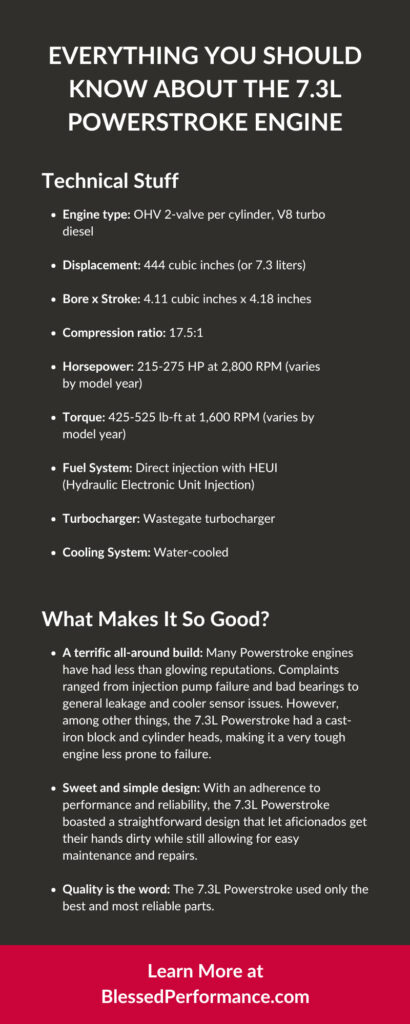
The 7.3L Powerstroke diesel engine represents a collaboration between Ford Motor Company and International Navistar that produced one of the most reliable diesel engines ever installed in a pickup truck. With a displacement of 444 cubic inches, this V-8 turbodiesel featured groundbreaking Hydraulic Electronic Unit Injection (HEUI) technology that used high-pressure engine oil to actuate the fuel injectors rather than a traditional mechanical injection pump. This innovative system created fuel pressures up to 21,000 PSI through a 7:1 multiplication effect, where 3,000 PSI of oil pressure from the high-pressure oil pump would generate the extreme fuel pressure needed for efficient combustion in the direct injection combustion chambers.
The engine’s physical specifications include a bore of 4.11 inches and a stroke of 4.18 inches, creating the largest displacement in the diesel truck segment at that time. The compression ratio of 17.5:1 was optimized for diesel fuel combustion, and the firing order of 1-2-7-3-4-5-6-8 provided smooth power delivery throughout the RPM range. Normal oil pressure ranges between 40-70 PSI at operating temperature, and the engine features a cast iron block with either forged steel or powdered metal connecting rods depending on the production year and specific engine serial number. The crankshaft is made from forged steel with hardened journals and fillets designed to resist wear even under extreme towing conditions.
Power Output Evolution Through the Years
The 7.3 Powerstroke crate engine platform saw several power increases throughout its production run as Ford refined the calibration and improved various components. Understanding these power specifications helps you select the right engine for your needs:
| Year | Horsepower | Torque | Notable Changes |
|---|---|---|---|
| 1994-1995 | 210 HP @ 2,300 RPM | 425 lb-ft @ 1,500 RPM | Initial Power Stroke introduction with HEUI injection |
| 1996-1997 | 225 HP @ 2,300 RPM | 450 lb-ft @ 1,500 RPM | Calibration updates and improved fuel delivery |
| 1999-2000 | 235 HP @ 2,700 RPM | 500 lb-ft @ 1,500 RPM | Super Duty platform, intercooler added, split-shot injectors |
| 2001-2003 (Auto) | 250 HP @ 2,800 RPM | 505 lb-ft @ 1,600 RPM | Final calibration for automatic transmissions |
| 2001-2003 (Manual) | 275 HP @ 2,800 RPM | 525 lb-ft @ 1,600 RPM | Highest factory power output with manual transmission |
The later model 7.3L engines from 1999-2003 are generally considered the most desirable because they came equipped with an air-to-air intercooler that significantly reduced intake air temperatures, improving both power output and reliability. These engines also featured split-shot injectors that provided better fuel atomization for cleaner combustion and slightly lower emissions. The addition of the intercooler alone made a substantial difference in engine performance under heavy loads, as cooler, denser air entering the combustion chambers allowed for more complete fuel burning and reduced exhaust gas temperatures during extended towing or hauling operations.
Types of 7.3 Powerstroke Crate Engines Available
When shopping for a 7.3 Powerstroke crate engine, you’ll encounter several different configurations and completion levels. Understanding the differences between long block, short block, and complete turnkey engines helps you make an informed purchasing decision based on your mechanical abilities, budget, and time constraints.
Long Block Powerstroke Engines
A 7.3 Powerstroke long block crate engine represents the most popular configuration for engine replacement projects. This package includes the fully assembled cylinder block with installed crankshaft, connecting rods, pistons, and rings, along with the complete cylinder heads, valve train components including camshaft and lifters, timing gears, front and rear covers, oil pan, oil pump assembly, and typically the high-pressure oil pump that’s critical to the HEUI injection system operation. Long blocks do not include external accessories like the turbocharger, fuel injectors, fuel lines, alternator, power steering pump, air conditioning compressor, or the intake and exhaust manifolds, which means you’ll need to transfer these components from your old engine to the new long block.
The pricing for professionally remanufactured 7.3 Powerstroke long block engines typically ranges from $7,500 to $12,000 depending on the specifications and upgrades included. For example, Kill Devil Diesel offers their Stage 1 long block for $7,499 with genuine Ford powdered metal connecting rods as standard, while their Stage 2 option with premium Carrillo forged connecting rods costs $12,649. Both options include a $2,000 core charge that you get refunded when you return your old engine block. Ford’s official remanufactured long block through their parts network costs approximately $10,411 with a $3,000 core charge, but these must be picked up at a Ford dealership rather than shipped directly to your location.
Complete Turnkey Crate Engines
For mechanics or truck owners who want the ultimate convenience, complete 7.3 Powerstroke crate engines arrive ready to install with virtually everything attached. These comprehensive packages include the entire long block assembly plus all external accessories, turbocharger, fuel injectors, fuel lines and rails, intake and exhaust manifolds, all necessary sensors including the injection control pressure sensor and camshaft position sensor, wiring harnesses, coolant lines, and often even the glow plugs already installed. The complete engine arrives on a pallet and can typically be installed in your truck within a single day by an experienced mechanic, compared to several days required to transfer all components from an old engine to a long block replacement.
Blackwater Engines offers complete running 7.3L Powerstroke diesel crate engines with a 2-year unlimited mileage nationwide warranty that can be serviced at any Ford dealership. Their engines include remanufactured turbochargers, HPOP units built to OEM specifications, new or remanufactured cylinder heads, diamond plateau honed cylinder bores, Magnafluxed crankshafts to check for cracks, and remanufactured fuel injectors tested with OEM equipment. These complete engines eliminate the guesswork and potential compatibility issues that can arise when mixing old components with new internal engine parts, and they’re particularly valuable if your old engine’s accessories and external components have already experienced wear or damage from the original engine failure.
Short Block Options
Short block Powerstroke diesel crate engines include just the engine block assembly with the rotating assembly installed, meaning you receive the block, crankshaft, connecting rods, pistons, rings, and usually the oil pump. You must then install your own cylinder heads, camshaft, lifters, timing components, and all covers. Short blocks are the least expensive option, typically starting around $3,100 to $3,500 depending on specifications, but they require significantly more labor and technical expertise to complete the installation. This configuration works best for experienced diesel mechanics who have the tools, knowledge, and time to properly install cylinder heads with correct torque sequences, adjust valve lash if required, and ensure all timing components are correctly positioned for proper engine operation.
Price Comparison and Value Analysis
Understanding the full cost of a 7.3 Powerstroke crate engine replacement involves more than just the engine purchase price. You need to consider core charges, shipping costs, installation labor, fluids and filters, and any additional parts that may need replacement during the engine swap. Here’s a comprehensive breakdown of costs you can expect:
Engine Base Prices:
- Used salvage yard engine: $2,500 – $4,500 (with 100,000+ miles, limited or no warranty)
- Short block remanufactured: $3,100 – $3,500 (plus core charge, extensive installation labor required)
- Long block remanufactured: $7,500 – $12,000 (plus core charge, moderate installation labor)
- Complete turnkey engine: $9,000 – $15,000 (plus core charge, minimal installation labor)
- Ford OEM remanufactured: $10,411 (plus $3,000 core, dealer pickup only)
Additional Costs to Consider:
- Core charge (refundable): $2,000 – $3,000
- Shipping to residential address: $400 – $800 (commercial addresses often cheaper)
- Installation labor: $1,500 – $3,500 depending on shop rates and engine type
- New fluids (oil, coolant, fuel filters): $200 – $300
- Miscellaneous gaskets, hoses, clamps: $150 – $300
- Potential additional repairs discovered during installation: Variable
The total investment for a 7.3L Powerstroke crate engine replacement typically ranges from $10,000 to $18,000 when factoring in all associated costs. However, this investment often makes financial sense when you consider that these engines are known to easily surpass 400,000 miles with proper maintenance, and many have joined the exclusive million-mile club. Compared to purchasing a newer used truck or dealing with the ongoing repair costs of a failing engine, a quality crate engine replacement can provide another 10-15 years of reliable service from your existing truck that you already know and trust.
Top Suppliers of 7.3 Powerstroke Crate Engines
Selecting the right supplier for your 7.3 Powerstroke crate engine purchase is just as important as choosing the engine specifications. The reputation, warranty terms, customer service, and quality control processes vary significantly between suppliers. Here are the leading providers in the industry:
Ford Motor Company Official Remanufactured Engines: Ford continues to offer officially remanufactured 7.3L Powerstroke crate engines through their parts network, despite the engine being out of production since 2003. These engines meet or exceed original factory specifications with rigorous quality control processes and testing. They come with a standard 2-year unlimited mileage warranty that’s honored at any Ford dealership nationwide, providing peace of mind if you experience problems on the road far from home.
The main drawback is that Ford engines must be picked up at a dealership rather than shipped, and they don’t offer any performance upgrades or improvements beyond stock specifications. The current listed price is $10,411.76 plus a $3,000 core charge, though promotional discounts may occasionally be available.
Kill Devil Diesel (KDD): Specializing in premium Powerstroke, Duramax, and Cummins engines and components, Kill Devil Diesel has earned an excellent reputation among diesel enthusiasts for quality craftsmanship and attention to detail. Their “Builder Series” 7.3 Powerstroke long block crate engines are engineered specifically for customers who demand the highest quality components and precise machining. KDD offers multiple configuration options including genuine Ford powdered metal connecting rods, factory forged rods, or premium Carrillo forged connecting rods depending on your power goals and budget.
Their Stage 1 engines start at $7,499 and their Stage 2 engines with upgraded internals cost $12,649, both plus a $2,000 core charge. KDD also sells comprehensive engine packages that include O-ringed cylinder heads, upgraded head gaskets, ARP head studs, and performance camshaft kits for customers building high-performance applications.
S&J Engines: With over 45 years of experience remanufacturing engines, S&J Engines has built a reputation for quality that exceeds OEM specifications. Their Ford 445 C.I. 7.3L Powerstroke diesel engines feature tighter machining tolerances, more new replacement parts than competitors typically use, and extensive bench testing before shipment. S&J emphasizes hand-machining and hand-building techniques that ensure every engine meets their exacting standards. Customer testimonials consistently praise S&J for knowledgeable staff, on-time delivery, and engines that run perfectly from the first start.
Their warranty terms are described as “industry disruptors” and they offer both stock replacement engines and custom-built performance options. S&J’s engines are so well-regarded that many other engine suppliers actually source their Powerstroke engines from S&J and rebrand them.
Asheville Engine, Inc.: Based in North Carolina, Asheville Engine specializes in remanufactured diesel engines and offers multiple configurations of 7.3 Ford Powerstroke engines for 1995 to 2003 Super Duty trucks. They provide long blocks without injectors (Ford part #XC3Z-6V012-BARM), long blocks with injectors included (Ford part #XC3Z-6006-AARM), and complete drop-in running engines (Ford part #XC3Z-6007-CARM). All Asheville engines are remanufactured using new parts where specified and carry a 2-year nationwide warranty serviceable at Ford dealerships.
They maintain detailed records and can provide compression test results and engine history information. Shipping costs are automatically calculated during checkout, with residential and rural deliveries typically costing about $200 more than commercial business addresses. They also stock OEM roller lifters for $275 per 16-piece set for customers doing their own engine rebuilds.
Blackwater Engines: Specializing exclusively in diesel engines, Blackwater Engines offers complete running 7.3L Powerstroke crate engines that arrive fully assembled with all components installed. Their engines feature diamond plateau honed cylinder bores to OEM specifications, new or remanufactured cylinder heads, Magnafluxed crankcases inspected for cavitation damage, remanufactured crankshafts, turbochargers built to OEM specs, fuel injectors tested with OEM equipment, and high-pressure oil pumps remanufactured to exact specifications. The 2-year unlimited mileage nationwide warranty provides comprehensive protection, and their pricing remains competitive at the middle range of the market. Blackwater also offers various upgrade options including forged connecting rods and performance fuel injectors for customers planning to increase power levels beyond stock.
Installation Considerations and Labor Requirements
Installing a 7.3 Powerstroke crate engine requires specialized knowledge, proper tools, and careful attention to detail to ensure reliable operation. The installation complexity and time required varies significantly based on whether you purchased a short block, long block, or complete engine package.
For a complete turnkey engine installation, expect 12-20 hours of labor for an experienced diesel mechanic working in a professional shop with proper equipment.
The process involves safely removing the old engine using an engine hoist with sufficient capacity for the 1,000+ pound diesel engine weight, cleaning the engine bay and inspecting all mounting points for damage or wear, installing the new engine onto the motor mounts while carefully aligning the transmission bellhousing, connecting all electrical connectors including the PCM communication wiring, installing all coolant hoses and ensuring the cooling system is properly bled of air pockets, connecting fuel supply and return lines with proper fittings, installing the turbocharger intake and exhaust connections, adding the correct quantity and specification of engine oil and diesel fuel, and finally performing initial startup procedures while monitoring for leaks, unusual noises, or error codes.
Long block installations require significantly more labor because you must transfer numerous components from your old engine including the turbocharger and all its associated piping, all eight fuel injectors which must be carefully removed without damaging the o-rings or copper sealing washers, high-pressure fuel rails and all fuel lines, intake and exhaust manifolds which may require new gaskets, all external sensors including the ICP sensor, EBP sensor, EOT sensor, CMP sensor, and CKP sensor, the alternator and its mounting brackets, power steering pump, air conditioning compressor, belts and pulleys, harmonic balancer, and various smaller components. This additional component transfer work typically adds 8-12 hours to the installation time, meaning total labor could reach 20-32 hours.
Short block installations represent the most labor-intensive option because in addition to all the component transfers required for a long block, you must also properly install the cylinder heads using the correct torque sequence, install the camshaft with proper timing alignment, set up the valve train with correct lash adjustments if using mechanical lifters, install all timing components and ensure proper gear mesh, and perform several other critical internal engine assembly steps that require specialized diesel engine knowledge and precision measuring tools. Most truck owners who purchase short blocks either have significant mechanical experience or are working under the guidance of a professional diesel mechanic who can ensure all critical specifications are met.
Performance Upgrades and Modifications
While stock 7.3 Powerstroke crate engines provide excellent reliability and adequate power for most applications, the platform responds exceptionally well to performance modifications that can significantly increase horsepower and torque output. Many crate engine suppliers offer upgraded components during the initial build, or you can add performance parts after installation.
The most cost-effective modification is a quality tuner or programmer that can add 50-140 horsepower by optimizing fuel delivery timing, increasing injection pressure duration, and adjusting the turbocharger wastegate control for higher boost levels. Popular options include the SCT X4 Power Flash Programmer, PHP Hydra Chip, and Edge Evolution CTS2. These electronic tuning solutions typically cost $400-$800 and can be installed in minutes by plugging into the OBD-II diagnostic port. Multiple power levels are usually available, allowing you to run a conservative tune for daily driving and fuel economy, or switch to an aggressive tune for towing or performance applications.
Fuel injector upgrades provide substantial power increases because the stock injectors, particularly in early model engines, are relatively small and can become restriction points when trying to produce higher power levels. Upgrading to larger injectors such as 175/146, 190/100, or 250/100 configurations (the numbers represent split-shot injection volumes) allows more fuel delivery per cycle. Quality remanufactured or new injectors from suppliers like Rosewood Diesel Injection, Full Force Diesel, or Warren Diesel cost $1,500-$3,000 for a complete set of eight, and they typically require professional installation and calibration to ensure proper operation. Many 7.3 Powerstroke crate engine suppliers offer injector upgrades as a factory-installed option when building your engine.
Turbocharger upgrades represent one of the most dramatic performance improvements you can make to a 7.3 Powerstroke. The factory Garrett GTP38 turbo uses a fixed geometry design that provides good reliability but limited performance potential. Upgrading to a larger frame T4-mounted turbocharger from manufacturers like BorgWarner or Garrett allows significantly more airflow throughout the RPM range. Popular choices include the BorgWarner S467.7 which can support over 600 horsepower, or the Garrett G42-1200 for extreme performance applications. Turbo upgrades typically cost $1,500-$3,500 for the turbocharger itself, plus mounting kits, exhaust manifold adapters, intake piping, and installation labor. Irate Diesel Performance manufactures comprehensive T4 turbo mounting systems specifically designed for 7.3 Powerstroke engines that simplify the installation process.
Warranty Coverage and Protection Plans
Understanding warranty terms is crucial when investing in a 7.3 Powerstroke crate engine because these policies determine what happens if you experience problems after installation. Warranty coverage varies significantly between suppliers, so read the fine print carefully before making your purchase.
Most reputable 7.3L Powerstroke crate engine suppliers offer a minimum 2-year warranty on remanufactured engines, with some extending coverage to 3 years or even offering unlimited mileage during the warranty period. Ford’s official remanufactured engines come with a 2-year unlimited mileage warranty that can be serviced at any Ford dealership nationwide, which provides exceptional convenience if you experience problems while traveling. The warranty typically covers all internal engine components including the block, crankshaft, connecting rods, pistons, camshaft, cylinder heads, and valve train components, but may exclude external accessories like the turbocharger, fuel injectors, or high-pressure oil pump unless specifically stated.
Important warranty exclusions and conditions you should understand include requirements for professional installation by a qualified mechanic with documentation of the work performed, use of proper fluids and filters meeting Ford’s specifications, adherence to break-in procedures during the first 500-1,000 miles, regular maintenance intervals being performed and documented, no modifications or performance tuning that exceeds the engine’s rated specifications, and proper diagnosis confirming that any failure was due to defective parts or workmanship rather than external causes like contaminated fuel, overheating, or oil starvation. Many warranties become void if the engine is used in commercial applications like towing services or if racing or competition use occurs.
Labor coverage represents another important warranty consideration. Some suppliers cover both parts and labor costs for warranty repairs, meaning they’ll pay the mechanic’s bill to remove the defective engine, diagnose the problem, and install replacement components. Other suppliers only cover the cost of replacement parts, leaving you responsible for paying labor charges that can easily exceed $2,000-$4,000 for major internal engine repairs. The best warranties offer nationwide coverage through a network of authorized repair facilities, ensuring you can get service regardless of where you’re located when problems occur. Always ask about labor coverage, deductibles, towing reimbursement, and whether a rental vehicle is provided during repairs before finalizing your 7.3 Powerstroke crate engine purchase.
Maintenance Requirements for Longevity
Proper maintenance is essential to ensure your 7.3 Powerstroke crate engine delivers the legendary reliability these engines are famous for. Following a comprehensive maintenance schedule prevents premature wear and helps identify potential problems before they cause catastrophic damage.
Oil change intervals should be respected religiously because the HEUI injection system depends on clean engine oil at proper pressure. Most manufacturers recommend oil changes every 5,000 miles for normal driving or 3,000 miles for severe duty applications like frequent towing, extended idling, or dusty conditions. Use high-quality diesel engine oil meeting Ford’s WSS-M2C171-E specification with the correct viscosity for your climate. Rotella T6 5W-40 full synthetic and Delo 400 XLE 15W-40 are popular choices among 7.3 Powerstroke owners. Always replace the oil filter with a quality unit like Motorcraft FL-1995 or equivalent, and consider sending used oil samples to Blackstone Laboratories every few changes to monitor internal wear metals and contamination levels.
Fuel filter maintenance is critical because the HEUI injectors contain extremely tight tolerances that can be damaged by contaminated fuel. The 7.3 Powerstroke uses a dual fuel filter system with both a primary and secondary filter. Replace both filters simultaneously every 15,000 miles or annually, whichever comes first, using quality replacements like Motorcraft filters or premium aftermarket options. When changing fuel filters, always prime the system properly to purge air from the fuel lines, and inspect the fuel filter housing for water accumulation or contamination that could indicate problems with your fuel supply.
Cooling system maintenance prevents overheating that can cause head gasket failures, cracked cylinder heads, or warped block surfaces. Flush and replace the coolant every 3 years or 50,000 miles using the correct Gold or Orange coolant specified for aluminum components. Inspect all hoses for deterioration, check the radiator for debris or damage, verify the thermostat opens properly at the correct temperature, and test the cooling fan operation including the hydraulic fan clutch that should engage under load. Monitor coolant temperature closely during towing or heavy loads, and address any overheating issues immediately before they cause permanent damage to your 7.3 Powerstroke crate engine.
Common Problems and Troubleshooting
Even quality 7.3 Powerstroke crate engines can experience problems, particularly as components age or if maintenance is neglected. Understanding common failure points helps you diagnose issues quickly and address them before catastrophic damage occurs.
Injector problems are among the most common issues affecting 7.3 Powerstrokes, particularly engines with over 125,000 miles on the original injectors. Symptoms include hard starting especially when cold, rough idle with excessive smoke, loss of power particularly under load, increased fuel consumption without apparent cause, and diagnostic trouble codes related to injection control pressure or cylinder contribution tests. Injectors can fail due to worn o-rings that leak oil or fuel, stuck injector spool valves from contamination or varnish buildup, or damaged injector tips from combustion pressures.
Professional diagnosis using a scan tool capable of running injector buzz tests or cylinder contribution tests can identify which injectors need replacement. Budget $200-400 per injector for quality remanufactured units, or consider replacing all eight simultaneously to prevent the need for repeated repairs.
HPOP (High Pressure Oil Pump) failures present dramatic symptoms because the entire injection system depends on oil pressure. Warning signs include extended cranking before starting, inability to start when hot after running normally when cold, loss of power with white or gray smoke from the exhaust, and rapidly declining injection control pressure readings on a scan tool. HPOP failures occur due to worn internal components, damaged seals allowing pressure loss, contaminated oil degrading the pump mechanism, or broken drive components.
Replacement involves removing the intake manifold for access, and quality replacement pumps from sources like Rotomaster or Adrenaline Diesel cost $400-800. Installing an HPOP at the same time as a 7.3 Powerstroke crate engine makes sense because labor is already being performed and the old pump may be compromised.
Turbocharger problems typically develop gradually with symptoms including loss of boost pressure reducing power output, excessive smoke from the exhaust particularly black smoke under acceleration, loud whining or grinding noises from the turbo, oil leaks from the turbo housing, or the check engine light with codes related to turbo performance. Turbo failures result from oil starvation due to neglected maintenance or plugged oil feed lines, contamination from failed engine components, extreme exhaust temperatures from excessive tuning, or simply wear from hundreds of thousands of miles.
The pedestal mount design of the GTP38 turbo makes it relatively easy to remove and replace, and quality rebuilt turbos cost $600-1,200 depending on specifications. Always replace the turbo oil feed line and clean the oil drain back tube when installing a replacement turbo to prevent premature failure.
Real-World Case Studies and Owner Experiences
Understanding how actual truck owners have benefited from 7.3 Powerstroke crate engine installations provides valuable perspective when making your decision.
Case Study 1 – Fleet Manager from Texas: A commercial landscaping company operating a fleet of six Ford F-350 Super Duty trucks with 7.3 Powerstroke engines faced a dilemma when one truck’s engine failed at 387,000 miles. Rather than retiring the truck, they invested in a complete turnkey 7.3 Powerstroke crate engine from Blackwater Engines costing $11,400 including installation. The owner reported that the new engine transformed the truck, providing power delivery that actually exceeded the original engine when new.
“The truck now pulls our loaded equipment trailers effortlessly, and fuel economy improved by nearly 2 MPG compared to before the old engine started failing. We were so impressed that we’re planning to replace engines in our other high-mileage trucks rather than buying new vehicles that cost $70,000 each. This decision will save our company over $200,000 while keeping the trucks we know and trust.”
Case Study 2 – Individual Owner from Michigan: A retired carpenter purchased a 2002 F-250 with a blown 7.3 Powerstroke at an insurance auction for $4,500. He invested in a Kill Devil Diesel Stage 1 long block for $7,499 and completed the installation himself over a weekend with help from his son. Total project cost including miscellaneous parts, fluids, and the engine came to approximately $8,800. “I now have a reliable truck worth at least $18,000-$22,000 in today’s market for a total investment under $14,000.
The engine runs absolutely perfectly, starts instantly in cold Michigan winters, and has no problems pulling my camper trailer on our vacation trips. The Kill Devil Diesel quality is exceptional – they provided excellent technical support during installation and the warranty documentation is comprehensive. This project gave me tremendous satisfaction, and I know I have a truck that will last another 300,000 miles with proper care.”
Case Study 3 – Commercial Towing Company from Colorado: A towing company specializing in heavy-duty recovery needed extreme reliability from their primary wrecker truck built on a Ford F-450 chassis. After experiencing persistent problems with injector failures and oil pump issues on their 285,000-mile original engine, they opted for an S&J Engines remanufactured 7.3L Powerstroke crate engine with upgraded forged connecting rods and heavy-duty oil pump. The $13,200 investment included installation and one year of extended warranty coverage.
“In the nine months since installation, this engine has been absolutely flawless in the most demanding conditions imaginable. We regularly perform recoveries in mountain passes at high altitude, often in extreme cold. The engine delivers consistent power, maintains proper oil pressure even during extended high-RPM towing, and has never given us a single problem. The S&J quality control is evident – they tested the engine thoroughly before shipment and provided detailed break-in instructions we followed precisely. This truck is our primary revenue generator, and we need absolute reliability. The S&J engine delivers exactly that.”
Finding the Best Deal on Your Crate Engine Purchase
Shopping strategically for a 7.3 Powerstroke crate engine can save thousands of dollars while ensuring you get quality components and reliable warranty coverage. Consider these approaches to find the best value.
Timing your purchase can affect pricing significantly because some suppliers offer seasonal promotions or clearance pricing on inventory they want to move. Fall and winter months typically see reduced demand for 7.3 Powerstroke crate engines as fewer people tackle major repair projects during cold weather, so suppliers may offer discounts to maintain cash flow. Black Friday and end-of-year sales events sometimes include engine packages, though availability on specific models varies. Contact multiple suppliers in October or November to inquire about upcoming promotions or whether they’ll discount engines purchased for winter delivery.
Negotiating package deals often produces better overall value than purchasing the engine alone. Ask suppliers if they’ll discount the price when you bundle related components like upgraded turbochargers, performance injectors, ARP head studs, or exhaust systems. Many suppliers maintain relationships with performance parts manufacturers and can source these items at dealer cost, then pass savings to you while still making a profit on the complete package. Even if listed prices seem firm, politely asking “what’s your best price if I order the engine plus these other components” might save 5-10% on the total purchase.
Comparing total delivered cost requires calculating more than just the advertised engine price. Factor in shipping costs which vary substantially based on your location and whether your address is commercial or residential, core charges and the hassle of properly crating and returning your old engine, warranty terms and coverage for parts plus labor, included components and whether you’ll need to purchase additional parts, technical support availability during and after installation, and reputation through independent reviews and references from past customers. A 7.3 Powerstroke crate engine that appears $1,500 cheaper might actually cost more when you factor in additional shipping charges, inferior warranty coverage, or the need to purchase components that competitors include as standard.
For those interested in learning about other engine types and general engine information, exploring resources like the information available for fairy tail 2 cheat engine optimization techniques can provide valuable mechanical insights.
Preparing Your Truck for Installation
Before your 7.3 Powerstroke crate engine arrives, preparing your truck and workspace ensures smooth installation and prevents delays or complications.
Pre-installation inspection should identify any additional components that need replacement while the engine is out of the truck. Check transmission condition including fluid color and smell, inspect the torque converter for leaks or damage, examine motor mounts for cracks or deterioration, assess the radiator for clogs or leak evidence, inspect all engine bay wiring harnesses for damage or corrosion, and verify that accessories like the alternator, power steering pump, and air conditioning compressor are functioning properly. Replacing worn components now saves money compared to discovering problems after installation when you must either live with issues or pay for additional labor to address them.
Gathering necessary tools and supplies prevents mid-project delays when you discover missing items. Essential tools include an engine hoist rated for at least 2,000 pounds capacity, load leveler attachment for controlling engine tilt during removal and installation, complete metric socket and wrench sets, torque wrenches capable of measuring 30-250 ft-lbs, specialty tools like injector pullers or valve cover removal tools, drain pans for capturing fluids, jack stands and wheel chocks for safety, and adequate lighting for working in the engine bay. Required supplies include proper engine oil (15 quarts for initial fill), coolant (4 gallons of correct specification), fuel filters, oil filter, various gaskets that may need replacement, thread sealant for certain connections, and assembly lube for initial startup.
Workspace preparation is crucial for safety and efficiency. Ensure you have adequate overhead clearance for removing the engine using the hoist, level concrete or asphalt surface for stability while the truck is lifted, electrical power for tools and lighting, clear area for staging removed components and organizing hardware, and proper ventilation if working in an enclosed space. Professional shops have alignment fixtures and specialized equipment that simplifies installation, but DIY mechanics can successfully complete the work with careful planning and attention to detail.
Break-In Procedures for Maximum Longevity
Proper break-in of your new 7.3 Powerstroke crate engine establishes piston ring seal, seats bearings correctly, and helps ensure optimal long-term performance and reliability.
Initial startup procedures require careful attention during the critical first minutes of operation. After installing all connections and filling the engine with proper fluids, prime the oil system by removing all glow plugs and cranking the engine until oil pressure appears on the gauge, which typically takes 10-30 seconds of cranking. Install the glow plugs and prepare for first start. Have a helper monitor gauges and watch for leaks while you control the engine.
Start the engine and immediately verify oil pressure within 5 seconds – shut down immediately if pressure doesn’t appear. Let the engine run at 1,200-1,500 RPM for 20-30 minutes while monitoring oil pressure, coolant temperature, and checking for any fuel, oil, or coolant leaks. This initial run-in helps establish critical clearances and seats components properly.
First 500 miles of operation represent the most critical break-in period where proper driving habits establish ring seal and bearing surfaces. Vary engine speed frequently rather than maintaining constant RPM for extended periods, which helps rings properly conform to cylinder walls. Avoid extended idle periods longer than 10 minutes during break-in because rings don’t seal properly at low cylinder pressures. Limit towing or heavy loads to 50% of normal capacity during this period.
Make several moderate acceleration runs where you accelerate firmly to 60-65 MPH then decelerate using engine braking – this technique helps establish ring seal through alternating cylinder pressures. Change oil and filter at 500 miles to remove break-in debris, metal particles, and assembly lubricants regardless of synthetic oil usage.
First 5,000 miles continue critical break-in as components continue settling into their permanent running conditions. Gradually increase towing capacity and load limits as the engine demonstrates proper oil pressure and no unusual symptoms. Perform oil changes at 1,000, 2,500, and 5,000 miles using quality diesel oil but not necessarily synthetic during break-in. Monitor oil consumption, fuel economy, and power delivery to establish baseline expectations for your 7.3 Powerstroke crate engine performance. Address any abnormal symptoms immediately rather than hoping they resolve themselves. After 5,000 miles, you can transition to normal maintenance intervals and full operational use including maximum towing capacity and performance tuning if desired.
Environmental Considerations and Emissions
Understanding emissions regulations and environmental impact helps ensure your 7.3 Powerstroke crate engine operates legally and responsibly in your jurisdiction.
Federal emissions compliance affects 7.3 Powerstroke owners differently depending on the truck’s model year and your location. The 7.3L Power Stroke predates most modern diesel emissions equipment like diesel particulate filters, selective catalytic reduction systems, or diesel exhaust fluid injection. The engine relies on the original emissions control devices including the exhaust gas recirculation (EGR) system that recirculates some exhaust gases back into the intake to reduce combustion temperatures and NOx formation, and the catalytic converter in the exhaust system that processes remaining emissions. Tampering with or removing these original emissions devices is illegal under federal law regardless of whether your state requires emissions testing, and penalties can include substantial fines.
State-specific regulations vary considerably regarding diesel emissions testing and compliance requirements. California maintains the strictest standards through their Air Resources Board (CARB) regulations that require all vehicles including diesels to pass emissions testing during registration renewal. Other states like Texas, Florida, and most rural states have minimal or no emissions testing requirements for diesel vehicles, though federal anti-tampering laws still apply. Before purchasing a 7.3 Powerstroke crate engine, verify that it includes all original emissions equipment if you live in a state with testing requirements. Some remanufactured engines ship without EGR components, which creates problems passing emissions testing even though the engine performs perfectly.
Responsible diesel ownership involves more than just legal compliance – it includes operating your truck in ways that minimize environmental impact. Proper maintenance including regular fuel filter changes prevents excessive black smoke from contaminated injectors. Quality fuel from reputable stations with high turnover reduces water and contamination problems. Avoiding unnecessary idling conserves fuel and reduces emissions. Using appropriate power levels through tuning means you’re not producing excessive smoke during acceleration. The 7.3 Powerstroke generation of diesels produces relatively clean emissions compared to older engines, and properly maintained examples create minimal visible smoke while delivering excellent fuel economy that reduces overall consumption compared to gasoline engines performing similar work.
Alternative Options to Consider
Before committing to a 7.3 Powerstroke crate engine purchase, evaluate whether alternative approaches might better serve your needs and budget.
Engine rebuilding represents a viable alternative if your existing engine block and main components are salvageable. Professional machine shops can completely rebuild your 7.3 Powerstroke with new pistons, rings, bearings, gaskets, and seals while machining the block and heads to proper specifications. Rebuilding costs typically range from $5,000-$8,000 for parts and machine work, plus $2,000-$3,500 for labor to remove, disassemble, reassemble, and reinstall the engine.
The advantage of rebuilding is retaining your original engine numbers which matters for some collectors and purists, and potentially saving $2,000-$4,000 compared to crate engine purchase. The disadvantage involves risks associated with machining older engine blocks that may have hidden damage, longer turnaround times of 2-4 weeks for machine work, and potential discovery of additional problems during disassembly that increase costs beyond original estimates.
Used engine replacement from salvage yards provides the lowest initial cost, typically $2,500-$4,500 for a running 7.3 Powerstroke engine removed from a wrecked truck. This approach works best if you can personally inspect the engine before purchase, verify compression readings on all cylinders, confirm oil pressure, and obtain documentation of mileage and maintenance history. The obvious disadvantage involves uncertainty about actual condition and remaining useful life, limited or no warranty coverage, potential for hidden damage not evident during inspection, and the possibility of simply trading one set of problems for another.
Some salvage yards offer warranties of 30-90 days, but this provides minimal protection for an engine expected to last years. Consider used engines only if your budget absolutely prohibits new or remanufactured options, and factor in the realistic possibility of needing another engine replacement within 50,000-100,000 miles.
Platform switching to 6.0L or 6.7L Power Stroke represents a significant undertaking but provides the benefits of more modern diesel technology including increased power output, improved fuel economy, and enhanced emissions compliance. Converting from 7.3L to 6.0L Power Stroke requires replacing the entire powertrain including engine, transmission, and PCM due to incompatibility, though some companies offer complete swap packages.
Conversion costs typically exceed $15,000-$20,000 including professional installation, which makes this option sensible only for someone specifically wanting the characteristics of the newer engine platform. The 6.7L Power Stroke conversion adds even more complexity and cost. For most owners, the proven reliability and simplicity of staying with the 7.3 Powerstroke crate engine platform makes more economic sense than attempting engine family conversions.
Frequently Asked Questions About 7.3 Powerstroke Crate Engines
What is the average lifespan of a 7.3 Powerstroke crate engine?
A properly maintained 7.3 Powerstroke crate engine typically lasts 300,000 to 500,000 miles before requiring major overhaul or replacement. Many examples have exceeded 400,000 miles on the original block with only routine maintenance including injector replacements, turbocharger rebuilds, and standard wear items. Some meticulously maintained examples have surpassed one million miles, earning the 7.3L Power Stroke its legendary reputation for durability. The actual lifespan depends on maintenance quality, operating conditions, whether the engine is tuned for additional power, towing frequency and load weights, and oil change intervals. Engines used primarily for highway driving with moderate loads typically outlast those subjected to frequent short trips, extended idling, or severe duty cycles.
Can I install a 7.3 Powerstroke crate engine myself or do I need a professional?
Installing a 7.3L Powerstroke crate engine is achievable for mechanically skilled DIY enthusiasts with proper tools, adequate workspace, and careful attention to procedures. Complete turnkey engines simplify installation compared to long blocks requiring component transfer, and short blocks demand the highest skill level including internal engine assembly knowledge. Essential requirements include an engine hoist and leveler, comprehensive metric tool sets, torque wrenches, service manuals for proper procedures and specifications, and sufficient time to complete the work without rushing. Most DIY installations take 16-30 hours spread over a weekend or longer depending on experience level and whether complications arise. Professional installation costs $1,500-$3,500 but includes proper diagnosis, warranty on the labor, and experience resolving unexpected problems that stump inexperienced mechanics.
What is the price difference between remanufactured and new 7.3 Powerstroke crate engines?
True “new” 7.3 Powerstroke crate engines aren’t manufactured anymore since Ford discontinued production in 2003, so all current options are either remanufactured engines using original Ford blocks or custom-built engines assembled from new aftermarket components. Remanufactured long blocks from reputable suppliers range from $7,500 to $12,000 plus core charges depending on specifications and upgrades. Complete turnkey remanufactured engines cost $9,000-$15,000 plus core charges. Custom-built engines using all new aftermarket blocks, crankshafts, and components from suppliers specializing in performance diesel builds can exceed $20,000-$30,000 for extreme applications, but these represent custom builds rather than standard crate engine offerings.
How much horsepower can a 7.3 Powerstroke crate engine handle with modifications?
Stock 7.3 Powerstroke crate engines with factory forged connecting rods reliably support 600-650 rear-wheel horsepower before internal components become the limiting factor. Engines with later-production powdered metal connecting rods should be limited to 450-500 rear-wheel horsepower to prevent rod failure. Upgrading to premium aftermarket connecting rods like Carrillo or Crower units allows power levels exceeding 800-1,000 rear-wheel horsepower, though additional upgrades to head studs, valve train components, and fuel system capacity are required for reliable operation at these extreme power levels. Most street-driven trucks with practical modifications including tuning, upgraded injectors, and improved turbochargers operate in the 400-550 rear-wheel horsepower range where reliability remains excellent with proper supporting modifications.
Does a 7.3 Powerstroke crate engine come with a warranty?
Reputable suppliers provide warranties on 7.3 Powerstroke crate engines ranging from 2 years to 3 years, with some offering unlimited mileage during the warranty period while others specify 100,000-mile limits. Ford’s official remanufactured engines include a 2-year unlimited mileage nationwide warranty serviceable at any Ford dealership. Warranty coverage typically includes all internal engine components but may exclude external accessories, and usually requires professional installation with documentation, proper maintenance, use of specified fluids, and adherence to break-in procedures. Some suppliers cover both parts and labor for warranty repairs, while others cover only replacement parts leaving you responsible for labor costs. Always review warranty terms carefully before purchase, and keep detailed maintenance records to support any warranty claims.
Are 7.3 Powerstroke crate engines suitable for towing heavy loads?
The 7.3 Powerstroke crate engine excels at towing applications due to its massive torque output, particularly at low RPM where towing demands peak power delivery. Stock engines produce 425-525 lb-ft of torque depending on model year, and even modest modifications can increase torque to 600-700 lb-ft. The HEUI injection system provides exceptional throttle response and power control for precisely modulating speed when navigating difficult terrain with heavy trailers. Maximum towing capacity depends on the truck’s chassis configuration including whether it’s a F-250, F-350, or F-450 model, single or dual rear wheels, two-wheel or four-wheel drive, and cab/bed configuration. Properly equipped F-350 dually models can safely tow 15,000-20,000 pounds with appropriate trailer brakes and weight distribution equipment.
Ready to Restore Your Ford Super Duty’s Power?
Don’t let a failed engine sideline your reliable Ford truck any longer. Investing in a quality 7.3 Powerstroke crate engine from a reputable supplier provides another 300,000-500,000 miles of dependable service for a fraction of the cost of purchasing a new truck. Whether you need a basic long block for a budget-conscious repair, a complete turnkey engine for convenient installation, or a performance-built powerplant with upgraded components for towing or recreational use, multiple suppliers offer configurations to match your exact requirements and budget.
Contact suppliers today to discuss your specific needs, compare pricing and warranty terms, and get your Super Duty back on the road delivering the legendary reliability that made the 7.3L Power Stroke one of the most respected diesel engines ever produced. Your truck deserves the quality and proven performance that only a professionally remanufactured 7.3 Powerstroke crate engine can provide.
Citation: Information in this article was compiled from multiple reputable sources including Ford Motor Company official specifications, Kill Devil Diesel technical documentation, S&J Engines engineering data, Asheville Engine product information, Blackwater Engines specifications, DieselHub technical resources, and extensive research from diesel enthusiast forums including PowerstrokeNation and TheDieselStop communities. All pricing and availability information was current as of publication date.