In this guide
Core Subject Matter and Curriculum Alignment
The textbook *Fundamentals of Electric Circuits*, authored by Charles K. Alexander and Matthew N. O. Sadiku, functions as a comprehensive reference designed to present the core principles of electric circuits alongside their practical applications [2]. The work targets students and practitioners navigating undergraduate electrical engineering coursework, focusing on the systematic analysis of both direct current (DC) and alternating current (AC) networks. The material establishes foundational knowledge around circuit topologies, passive element behavior, and network theorems, making it a standard resource for introductory circuit analysis sequences [5].
Key technical coverage includes the identification and manipulation of resistors, capacitors, inductors, operational amplifiers, switches, and both independent and dependent voltage/current sources [5]. The text grounds its analytical frameworks in established physical laws, explicitly emphasizing Ohm’s law for voltage-current-resistance relationships and Kirchhoff’s laws for tracking current at junctions and voltage across closed loops [4]. These principles form the baseline for more advanced problem-solving, including transient response, frequency-domain analysis, and steady-state AC calculations.
For readers evaluating this title for academic or professional reference, it is important to recognize that the book operates primarily as a theoretical and analytical guide. While it outlines how circuits manipulate and generate electrical signals for applications in power generation, communication technologies, and instrumentation [4], the text itself does not serve as a hands-on laboratory manual. Learners seeking immediate prototyping guidance should plan to supplement the reading with circuit simulation software or physical breadboarding exercises. The structured presentation of definitions, worked examples, and end-of-chapter problems aligns with standard university-level engineering pedagogy, making it suitable for classroom adoption or structured self-study.
Structural Organization and Learning Framework
The pedagogical architecture of the textbook follows a deliberate progression from basic concepts to complex system analysis. Chapter 1 introduces circuit topologies and DC excitation, establishing the electrical properties of materials and defining passive elements [5]. Early sections include targeted review questions that prompt readers to define conductors versus insulators, describe electron flow mechanics, explain Ohm’s law, and articulate Kirchhoff’s circuit laws [5]. These embedded checkpoints are designed to reinforce conceptual retention before advancing to mathematical derivations.
Following the introductory material, the text transitions into systematic circuit analysis techniques. Standard methodologies such as nodal analysis, mesh analysis, superposition, Thévenin and Norton equivalents, and maximum power transfer are typically developed through step-by-step examples. The inclusion of multiple-choice question banks and answer keys provides a self-assessment mechanism for readers working independently [5]. This format supports iterative learning, allowing students to verify their computational approaches against published solutions before progressing to multi-component networks.
When researching the table of contents, prospective buyers should note that catalog listings generated by external libraries may contain coding artifacts or structural variations compared to the printed volume [1]. The Library of Congress subject headings confirm the publication’s focus on electric circuits, but the accompanying table of contents is machine-generated from pre-publication publisher data and may be incomplete or differ slightly from the final bound edition [1]. To avoid purchasing a mismatched version, readers should cross-reference the ISBN, confirm the exact chapter sequence through the retailer’s preview, or consult the official publisher catalog before completing a transaction.
Edition Comparisons and Regional Considerations
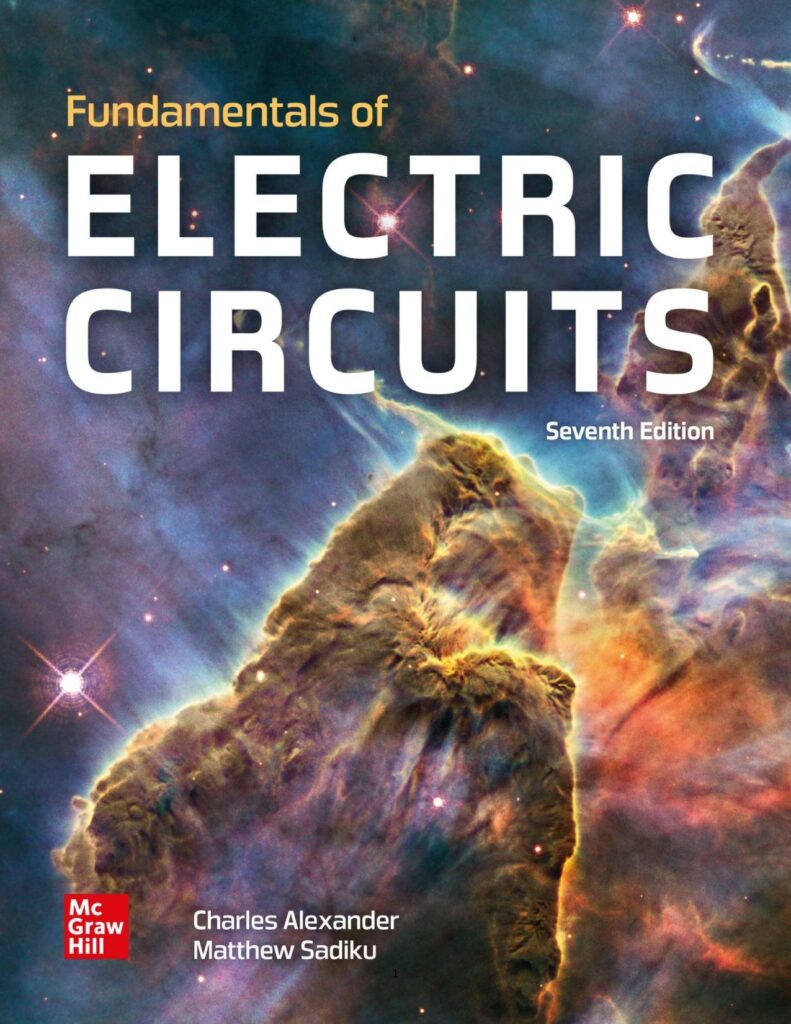
Multiple printings of this title exist, with notable updates spanning several years. The fifth edition, copyrighted in 2013 by The McGraw-Hill Companies, Inc., builds upon previous iterations from 2009, 2007, and 2004 [3]. The seventh edition, published by McGraw-Hill Education in 2021, reflects continued revisions to problem sets, explanatory pacing, and alignment with modern engineering curricula [6]. Both editions maintain the same primary authorship team: Charles K. Alexander, Professor Emeritus of Electrical Engineering and Computer Science at Cleveland State University, and Matthew N. O. Sadiku, faculty within the Department of Electrical and Computer Engineering at Prairie View A&M University [3][6].
Regional distribution and ancillary access vary significantly between editions and geographic markets. The fifth edition explicitly notes that certain ancillaries, including electronic and print components, may not be available to customers outside the United States [3]. This restriction often impacts students enrolling in non-US institutions who attempt to import US-printed copies, as access codes for companion websites, digital homework platforms, or solution manuals may be region-locked or expired. Additionally, the seventh edition includes an International Student Edition designation, which typically indicates different cover formatting, localized pricing structures, and potentially adjusted page sequencing to accommodate overseas printing contracts [6].
For commercial investigation purposes, edition selection should be driven by course syllabi, institutional licensing agreements, and regional ancillary availability. Readers should verify whether their program mandates a specific copyright year, whether digital access codes are bundled with new purchases, and whether the US or International edition aligns with local accreditation standards. Textbook specifications, pricing tiers, and format options (hardcover, paperback, loose-leaf, or digital) shift frequently based on publisher promotions, semester cycles, and retail partnerships. Before finalizing a purchase, readers must verify the current manufacturer or retailer listing to confirm active stock, discount eligibility, shipping windows, and bundle contents.
Practical Limitations and Pre-Purchase Verification
While the textbook delivers rigorous theoretical coverage, several practical constraints warrant attention during the evaluation phase. First, the machine-generated nature of some third-party catalog tables of contents means chapter titles, section breaks, or problem groupings listed on aggregator sites may not reflect the final printed layout [1]. Second, ancillary digital resources tied to specific editions are frequently restricted by geographic IP validation or academic institution licensing, which can render companion platforms inaccessible if purchased outside the intended distribution territory [3]. Third, the text emphasizes analytical problem-solving over experimental prototyping, meaning readers expecting immediate hardware setup instructions will need to integrate separate laboratory guides or simulation tutorials [4][5].
To navigate these constraints, buyers should follow a structured verification protocol:
– Confirm the exact ISBN and publication year against your course syllabus or departmental requirements.
– Verify whether the retailer listing includes active access codes for digital homework platforms, and check the code’s expiration date and regional activation rules.
– Cross-reference the table of contents using the publisher’s official website or a verified academic library record rather than relying solely on automated catalog previews.
– Assess whether the US or International edition aligns with your location, particularly if you require guaranteed access to supplementary e-components or instructor resources [3][6].
– Monitor pricing and availability fluctuations, as textbook retail values change weekly based on inventory turnover, seasonal demand, and promotional calendars. Always verify the current manufacturer or retailer listing before checkout.
Target Audience and Implementation Strategy
This textbook is best suited for electrical engineering undergraduates taking their first dedicated circuit analysis course, as well as self-directed learners preparing for professional licensing examinations or transitioning into related technical fields. The sequential build-up from fundamental charge conservation and electron flow mechanics to advanced network theorems provides a logical scaffolding for beginners [4][6]. Readers unfamiliar with electromotive force, algebraic charge summation, or directional current conventions will find the early chapters establish necessary groundwork before introducing compound circuit configurations.
For optimal implementation, the text performs most effectively when paired with active problem-solving routines. Students should treat the review questions and multiple-choice assessments as diagnostic tools rather than optional supplements [5]. Working through the end-of-chapter problems methodically, verifying intermediate calculations, and comparing results against provided answer keys reinforces computational accuracy. When possible, learners should simulate selected circuits using free or educational-tier software to visualize voltage drops, current splits, and component interactions before attempting manual derivations.
Instructors adopting the text for classroom instruction can leverage its structured review questions to design quick concept checks or peer discussion prompts. The inclusion of standardized test-style items supports exam preparation and allows educators to gauge class-wide comprehension before advancing to more complex topics like three-phase power systems or frequency-dependent impedance networks [3][5]. It is worth noting that nearly all commercial electric power is generated and distributed using three-phase configurations operating at 60 Hz in the United States, making those later chapters particularly relevant for North American engineering programs [3].
Final Assessment for Buyers
*Fundamentals of Electric Circuits* remains a widely referenced academic resource for introductory circuit analysis, offering clear theoretical explanations, structured problem sets, and alignment with standard engineering curricula. The authors’ consistent academic affiliations and the publisher’s long-standing distribution history contribute to its institutional adoption rate. However, successful acquisition depends on careful edition matching, regional ancillary verification, and realistic expectations regarding hands-on versus analytical content.
Readers evaluating this title for commercial purchase should prioritize ISBN confirmation, validate digital access code availability for their region, and cross-check the printed table of contents against official publisher records. Pricing, stock levels, discount eligibility, shipping timelines, and included accessories are subject to frequent change across retailers and must be verified on the current manufacturer or store listing before checkout. By following these verification steps and pairing the text with appropriate simulation or laboratory supplements, buyers can maximize the educational return on investment and ensure the volume aligns precisely with their academic or professional objectives.
Sources
[1] https://catdir.loc.gov/catdir/toc/ecip0819/2008023020.html\n[2] https://www.researchgate.net/publication/380831178_Fundamentals_of_Electric_circuits\n[3] https://www.kaizen-ju.com/storage/images/files/file_17265317748jBDU.pdf\n[4] https://www.ebsco.com/research-starters/engineering/electrical-circuits\n[5] https://dokumen.pub/fundamentals-of-electrical-circuits.html\n[6] https://www.slideshare.net/slideshow/circuits-electric-fundamentals-7th-ed-pdf/286497632