In this guide
Navigating Capstone Project Requirements in Electrical Engineering Programs
The capstone project serves as the culminating academic experience for most undergraduate electrical and electronic engineering (EEE) degree pathways. Rather than functioning as a traditional exam, this requirement demands that you synthesize years of theoretical study into a tangible, engineered solution. While institutional formats differ, the underlying expectations remain highly consistent across accredited programs. This guide breaks down the universal requirements, provides a step-by-step execution framework, and outlines exactly what you must verify with your department before committing to a topic.
Step 1: Audit Your Program’s Catalog and Prerequisites
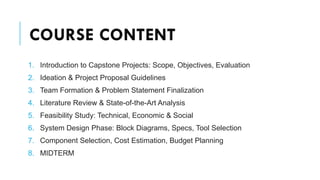
Capstone sequences are rarely standalone electives; they are tightly integrated into your final-year curriculum. Begin by locating your university’s official engineering catalog and identifying the exact course code for your senior design track. Many programs structure the capstone as a two-semester sequence spanning multiple credit hours, often ranging from one to six credits depending on institutional pacing [1].\n
Before enrollment, confirm that you satisfy all prerequisite milestones. Some departments require completion of advanced circuit analysis, control systems, or microcontroller programming courses, alongside formal admission to the College of Engineering [1]. If you lack a specific prerequisite, document which alternative coursework or faculty permission might substitute for it, and submit that request in writing to your academic advisor. Missing a prerequisite mid-semester can delay graduation, so verify eligibility at least one term ahead of your intended start date.
Step 2: Map Requirements Against Accreditation Standards
Your program’s rubric will almost certainly align with national accreditation benchmarks. The capstone requirement was formally introduced to engineering curricula in the late 1980s to address industry demand for structured design education, and it was further refined in subsequent accreditation cycles to emphasize applied competencies [3]. When reviewing your syllabus, look for these mandated elements:
– Project definition and structured planning
– Scheduling methodology and milestone tracking
– Effective written and oral communication of technical concepts
– Integration of realistic constraints and recognized engineering standards
– Functioning within a multidisciplinary team environment
– Adaptive problem-solving when initial approaches fail [1]
Cross-reference your program’s checklist against current accreditation guidelines for your graduation cohort. Accreditation criteria evolve, and your department’s published requirements may lag behind the latest published standards. Request the most recent accreditation self-study summary or curriculum mapping document from your engineering office to ensure full alignment.
Step 3: Define Scope, Multidisciplinary Integration, and Real-World Application
A successful capstone cannot exist in a vacuum. Programs expect you to design, build, and test solutions that address complex, real-world engineering challenges rather than isolated textbook exercises [2]. Your project should naturally span at least two core EEE domains, such as hardware design paired with embedded software, power electronics combined with communications protocols, or control systems integrated with sensor networks [2].
When brainstorming topics, prioritize applications that handle live operational conditions or simulate industrial environments [4]. For example, designing a regulated power conversion system that manages AC-to-DC transformation, isolates high-voltage stages, and negotiates digital charging protocols mirrors actual commercial development workflows [2]. Similarly, building instrumentation for power factor metering demonstrates measurable signal processing and correction capabilities [2].\n
Once you identify a concept, verify its scope with your assigned faculty advisor. Ensure the project meets the multidisciplinary expectation and contains sufficient complexity to sustain a full semester of iteration. If your initial idea leans heavily toward simulation or theoretical analysis alone, expand it to include physical prototyping, bench testing, or field validation before proceeding.
Step 4: Draft Core Deliverables and Technical Documentation
Documentation is not an afterthought; it is a graded component of nearly every EEE capstone. Standard deliverables typically include detailed system specifications, comprehensive design documents, schematic captures, layout files, and user or maintenance manuals [6]. Honors-track participants may additionally face independent research expectations, requiring a formal thesis manuscript and a structured presentation to both departmental and college-level committees [1].
Establish a centralized repository for all project artifacts from day one. Version-control your schematics, maintain a lab notebook or digital log of experimental results, and archive firmware or software builds with clear commit messages. Academic advisors consistently evaluate how clearly you translate engineering decisions into written format, so treat your documentation as a professional engineering report rather than a student assignment. Request your department’s official template or style guide early, as formatting penalties are common even when technical content is strong.
Step 5: Embed Practical Constraints and Safety Protocols
Real engineering exists within boundaries. Your capstone proposal must explicitly address how you will navigate non-technical and systemic constraints. Accreditation frameworks require projects to incorporate considerations including economic viability, environmental impact, sustainability goals, manufacturability, ethical implications, health and safety protocols, social utility, and political or regulatory factors [3].\n
For electrical and electronic systems, safety takes precedence. Designs involving mains voltage, high-current paths, or isolated power stages must demonstrate proper isolation techniques, thermal management strategies, and protective circuitry to prevent equipment damage or operator injury [2]. Document your risk assessment, list applicable safety standards (such as IEEE or IEC guidelines relevant to your region), and describe mitigation steps for each identified hazard. If your project touches consumer-facing technology, verify local certification requirements before beginning production runs.
Step 6: Execute Prototyping, Testing, and Iteration
The build phase transforms your specifications into measurable performance. You will likely work with development platforms, reference literature, and modular hardware to accelerate validation. Many undergraduate laboratories incorporate accessible microcontroller ecosystems, such as the Arduino Uno Starter Kit, alongside foundational reference texts like Fundamentals of Electric Circuits or comprehensive Electrical Engineering Reference Book Sets to support rapid learning and troubleshooting [P1][P2][P3].\n
Note: Product pricing, stock levels, discounts, shipping timelines, package contents, and technical specifications change frequently. Always verify current manufacturer or retailer listings before making purchases or relying on advertised features.
During prototyping, follow a strict test-and-validate cycle. Compare measured waveforms, efficiency curves, or communication latency against your initial specifications. Record deviations, root-cause failures, and design modifications in your project log. If a subsystem consistently underperforms, pivot to an alternative topology or adjust your system architecture rather than forcing a flawed approach. Advisors expect adaptive engineering; they do not penalize course corrections documented with clear technical justification.
Step 7: Prepare Final Communications and Defense Materials
The capstone concludes with a formal demonstration and oral defense. Programs require students to effectively communicate technical ideas through both written reports and live presentations [1]. Your defense typically occurs in front of faculty reviewers, industry guests, or cross-departmental panels who will probe your design choices, constraint management, and testing methodology.
Structure your presentation to highlight problem definition, architectural decisions, safety and constraint analysis, test results, and lessons learned. Prepare visual aids that clearly show block diagrams, PCB layouts, firmware flowcharts, and oscilloscope captures. Rehearse timing strictly, anticipate questions about trade-offs and failure modes, and bring backup copies of your key deliverables. If your program offers a public exhibition or poster session, coordinate booth logistics, labeling, and demonstration safety protocols well in advance.
Common Verification Points for EEE Capstone Courses
Capstone expectations contain inherent variability across institutions. Use this checklist to eliminate ambiguity before enrolling or launching your project:
– Course Codes & Credits: Verify whether your program uses a single-semester or two-semester sequence, and confirm total credit hour allocations [1].
– Prerequisite Alignment: Confirm that completed coursework satisfies departmental gates, and obtain written permission if substituting equivalent classes [1].
– Accreditation Mapping: Request the latest ABET-aligned curriculum matrix to ensure your project covers all mandated design and communication outcomes [3].
– Deliverable Format: Obtain official templates for specifications, design reports, and user manuals to avoid formatting deductions [6].
– Hardware Procurement: Validate component lead times, verify that recommended development kits or reference books match current editions, and confirm return policies for unused electronics [P1][P2][P3].
– Safety & Compliance: Identify applicable electrical safety standards, isolation requirements, and local certification pathways before assembling prototypes [2][3].
– Advisor Availability: Schedule biweekly check-ins early in the term to maintain schedule adherence and secure timely feedback on milestones [1].
By systematically auditing requirements, documenting constraints, validating designs against real-world standards, and preparing rigorous technical communications, you will satisfy the core expectations of any accredited EEE capstone program. Always defer to your department’s published syllabi and accreditation updates, as institutional policies and industry standards continue to evolve.
Sources
[1] https://catalog.unl.edu/undergraduate/engineering/electrical
[2] https://eece.wwu.edu/eece-capstone-projects
[3] https://phines.w3.uvm.edu/publications/2001/hines_ms_thesis.pdf
[4] https://phdservices.org/capstone-project-for-electrical-engineering
[5] https://www.scribd.com/document/328980185/ET410-Scope-of-the-Capstone-Project
[6] https://www.researchgate.net/publication/220807089_Providing_Process_for_Projects_in_Capstone_Courses
Reader discussion