In this guide
Key Takeaways
- The 6.7L Powerstroke represents Ford’s third generation of purpose-built Super Duty diesel engines, producing 450 hp and 935 lb-ft of torque (2017+)
- Common issues include CP4.2 fuel pump concerns, EGR cooler restrictions, and turbocharger maintenance needs—later model years (2015+) addressed many early reliability concerns
- Standard oil change intervals run approximately 7,500-10,000 miles, with shorter intervals recommended for severe duty applications
- The 6.7L offers substantial improvements over the 6.0L in bottom-end strength and overall reliability
- Performance upgrades exist across a wide spectrum, from conservative tuning to dedicated competition builds
Engine Specifications and Design Overview
The 6.7L Powerstroke represents Ford’s third generation of purpose-built diesel engines for the Super Duty platform, marking a substantial departure from previous designs. This engine introduced significant architectural changes that addressed the shortcomings of earlier Powerstroke variants while meeting increasingly stringent emissions requirements.
Core Specifications
The 6.7 Powerstroke engine features a 6.7-liter (406 cubic inch) V8 configuration with a 32-valve cylinder head design. Key specifications include:
- Displacement: 6.7 liters (406 cubic inches)
- Configuration: 90-degree V8, 32-valve SOHC with dual cylinder heads (one per bank)
- Bore x Stroke: 103.1mm x 99.9mm
- Compression Ratio: 16.2:1
- Base Horsepower: 450 horsepower (2017+) with earlier models producing 440 hp (2011-2016)
- Base Torque: 935 lb-ft (2017+) with earlier models producing 860 lb-ft (2011-2016)
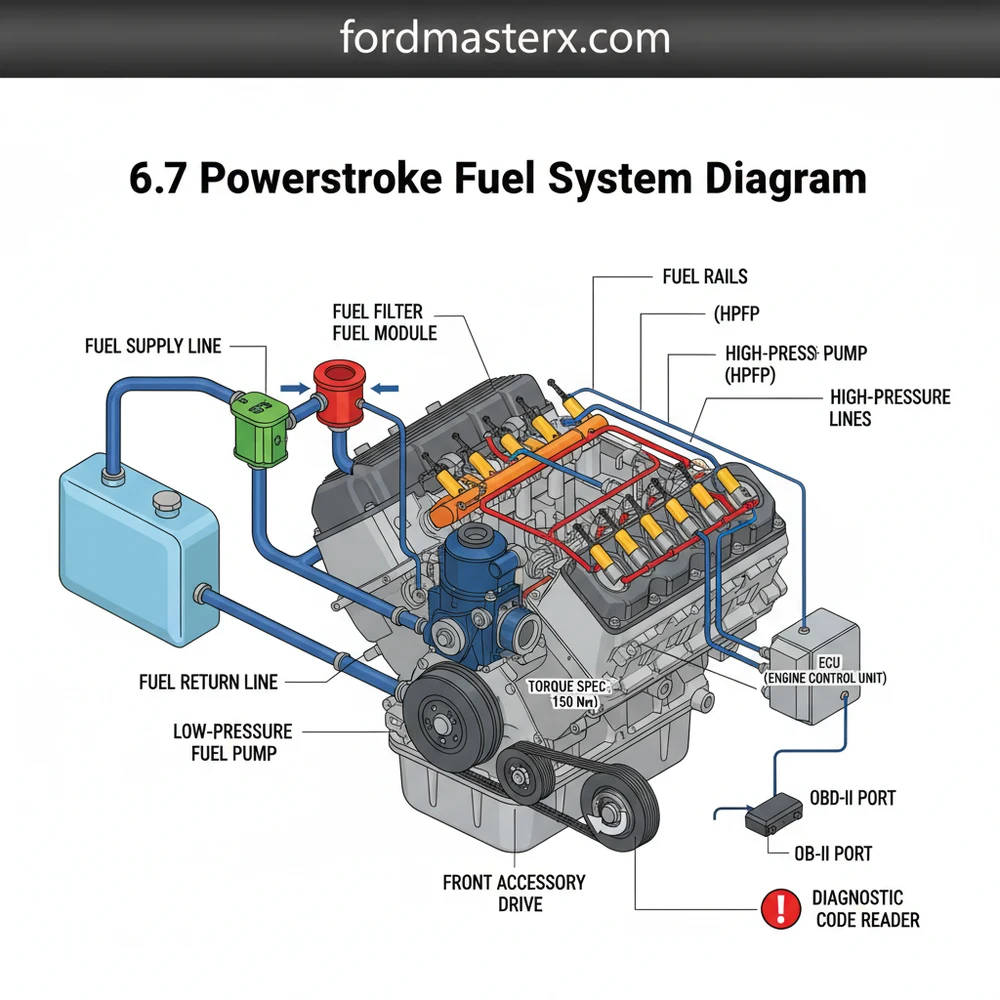
- Fuel System: High-pressure common rail with CP4.2 pump
- Turbocharging: Single sequential turbocharger with variable geometry turbine housing
Design Improvements Over Previous Generations
Ford engineers designed the 6.7L Powerstroke from a clean sheet, incorporating several key improvements over the problematic 6.0L and the earlier 7.3L engines. The bottom end received a beefier design featuring a redesigned block with cross-bolted main bearings, stronger connecting rods, and a forged crankshaft. These changes significantly improved bottom-end rigidity and reduced the likelihood of main seal leaks and bearing failures that plagued earlier designs.
The cylinder head design uses dual cylinder heads—one per bank—with optimized intake and exhaust passages for improved flow characteristics and combustion efficiency. The use of compacted graphite iron (CGI) for the block provides superior strength-to-weight ratio compared to traditional gray iron while reducing noise and vibration.
The turbocharger system represents a significant advancement, featuring a single turbo with a turbine housing that adjusts geometry based on operating conditions. This design delivers quick throttle response at low engine speeds while maintaining boost pressure during high-load situations. The turbo sits in the engine’s valley, fed by oil from the main galley, and uses cooled exhaust gas recirculation (EGR) to reduce combustion temperatures.
Reliability Analysis: Common Problems and Failure Modes
Understanding the most frequently reported issues with the 6.7 Powerstroke engine helps owners prioritize maintenance activities and recognize early warning signs. While the 6.7L represents a substantial improvement over earlier Powerstroke generations, certain components warrant attention based on real-world owner feedback and service records.
CP4.2 High-Pressure Fuel Pump
The CP4.2 high-pressure fuel pump has generated more owner concern than perhaps any other component on early 6.7L Powerstroke engines. This pump generates fuel pressures exceeding 30,000 PSI to support the common rail injection system. When the CP4.2 fails—typically through internal scuffing of the pump’s internal surfaces—it can contaminate the fuel system with metallic debris.
Early model year vehicles have reported fuel pump issues at various mileage points, with some owners reporting concerns within the 50,000-100,000 mile range. Ford responded with design improvements in later model years and extended warranty coverage for fuel system components on certain applications. The failure mode typically manifests as sudden loss of power, illuminated check engine light, and codes related to fuel pressure or pump performance.
Many owners mitigate this risk by installing a fuel system bypass kit that adds a secondary filtration stage before fuel reaches the CP4.2 pump, catching contamination before it reaches the pump internals.
EGR Cooler Issues
Exhaust gas recirculation (EGR) coolers on the 6.7L can develop internal restrictions from carbon buildup, leading to elevated cylinder head temperatures and reduced engine performance. The EGR cooler uses engine coolant to reduce the temperature of recirculated exhaust gases before they enter the intake manifold. Over time, exhaust deposits can accumulate inside the cooler, restricting flow and reducing cooling efficiency.
Symptoms of EGR cooler problems include elevated engine temperatures, reduced power under load, increased fan operation, and white or gray exhaust smoke. In severe cases, the EGR cooler may develop external coolant leaks. Ford has issued several technical service bulletins addressing EGR cooler warranty coverage and replacement procedures.
Turbocharger Concerns
The factory turbocharger on the 6.7 Powerstroke has proven generally reliable, but certain failure modes appear with enough frequency to warrant discussion. Wastegate rattle—particularly noticeable at low speeds under light load—results from carbon accumulation on the wastegate mechanism. This condition typically doesn’t affect performance but creates an annoying rattling sound.
More serious turbo failures involve shaft bearing wear leading to shaft play and compressor wheel contact. These failures often stem from oiling issues, either from restricted oil lines or extended oil change intervals that allow contaminants to accumulate. Regular oil changes with quality filters and periodic inspection of turbo oil supply lines help prevent these failures.
Oil Cooler Restrictions
The engine oil cooler on the 6.7L can become restricted by debris accumulation, leading to elevated oil temperatures and reduced engine protection. The oil cooler uses engine coolant to remove heat from the oil, and restricted passages reduce cooling efficiency. Symptoms include higher-than-normal oil temperatures, reduced oil pressure at idle, and in severe cases, oil filter bypass activation.
Oil cooler replacement requires significant labor hours as the cooler sits behind the timing cover area, but addressing this issue promptly prevents more costly engine damage from overheating.
Head Gasket and Cylinder Head Concerns
While less common than issues with the 6.0L Powerstroke, the 6.7L can develop head gasket failures, particularly on high-mileage vehicles or those subjected to repeated overheating. The 6.7L features dual cylinder heads (one per bank), which can complicate head gasket repair compared to single-head designs.
Some owners have reported cylinder head issues between valve seats, particularly on early production engines. Ford has addressed specific cases under warranty and extended coverage for certain model years. Symptoms include coolant loss without visible external leaks, white exhaust smoke, and external coolant seepage near the cylinder head areas.
Early vs. Later Model Year Reliability
The 6.7L Powerstroke underwent significant revisions throughout its production run. 2011-2014 models represented the first generation and experienced higher rates of reported fuel pump and EGR cooler issues. 2015-2016 models incorporated numerous component improvements and updated calibrations that improved reliability. 2017+ models received the most extensive updates, including increased horsepower and torque ratings, updated internal components, and refined emissions system integration.
Comprehensive Maintenance Schedule and Best Practices
Consistent maintenance represents the single most important factor in achieving reliable service from your 6.7 Powerstroke engine. Following recommended service intervals while adapting to your specific usage conditions protects expensive components and maintains warranty coverage.
Engine Oil and Filter Changes
Engine oil serves as the lifeblood of your 6.7L Powerstroke, providing lubrication for moving parts, heat dissipation, and protection against corrosion. Ford specifies synthetic oil meeting API CJ-4 or CK-4 specifications for all 6.7L engines.
Standard Intervals: Every 7,500-10,000 miles or 12 months, whichever comes first
Severe Duty Adjustments: Every 5,000 miles for vehicles used in the following conditions:
- Frequent towing exceeding 50% of vehicle’s maximum capacity
- Extended idling exceeding 30 minutes per day on average
- Operating in temperatures below 10°F or above 100°F
- Dusty or sandy environments
- Regular short trips under 10 miles without reaching full operating temperature
- Off-road or commercial fleet applications
Always verify oil level when the engine is warm and the vehicle sits on level ground. The 6.7L should not consume oil between changes when healthy, so any oil level drop warrants investigation before the next service interval.
Fuel Filter Replacement
The 6.7L Powerstroke uses a two-stage fuel filtration system. The primary fuel filter (mounted on the frame rail) removes water and large particles before fuel reaches the CP4.2 pump. The secondary filter (mounted on the engine) provides final filtration before fuel enters the high-pressure common rail.
Primary Filter: Replace every 15,000 miles or 2 years, whichever comes first
Secondary Filter: Replace every 15,000 miles or 2 years, whichever comes first
Water Separator Draining: Check and drain weekly in humid climates, monthly in dry climates
Fuel filter replacement involves bleeding the system afterward, which requires either using the ignition key prime function or specialized diagnostic equipment. Many owners prefer professional service for fuel filter changes due to the complexity of the bleeding procedure.
Diesel Exhaust Fluid (DEF) Management
The 6.7L Powerstroke uses DEF (also known as AdBlue) as part of the selective catalytic reduction (SCR) emissions system. DEF is injected into the exhaust stream before the SCR catalyst, where it reacts with NOx emissions to produce nitrogen and water vapor.
DEF Consumption: Varies by operating conditions; drivers report approximately 2-3% of diesel fuel consumption in typical use
DEF Tank Capacity: Varies by model—refer to your owner’s manual for specific capacity
Refill Interval: Varies based on tank size and actual consumption; many owners report refilling every 5,000-7,000 miles depending on driving style and load
DEF freezes at 12°F, but the vehicle includes heater elements to thaw DEF before use. Use only API-certified DEF meeting ISO 22241 specifications. Low DEF levels trigger progressive warning levels before system lockout prevents vehicle operation.
Diesel Particulate Filter (DPF) Maintenance
The DPF captures soot particles from exhaust gases and periodically burns them off through regeneration cycles. Understanding DPF maintenance helps prevent costly replacements and performance issues.
Passive Regeneration: Occurs automatically during highway driving when exhaust temperatures are high enough to burn accumulated soot
Active Regeneration: Triggered by the engine computer when soot levels reach certain thresholds, increasing exhaust temperatures artificially
Service Indicators: Watch for illuminated DPF warning light—extended neglect can require dealer service to clear codes and reset monitoring systems
Short-trip driving that prevents the vehicle from reaching operating temperature accelerates DPF loading. If your primary use involves trips under 20 minutes, periodic extended highway drives help maintain proper DPF function.
Coolant System Service
The 6.7L Powerstroke uses extended-life coolant specified by Ford. Coolant service intervals depend on the type used:
Motorcraft Orange Coolant (Prediluted): 100,000 miles or 6 years (whichever comes first)
Motorcraft Orange Coolant (Concentrated): Consult your owner’s manual for specific interval—typically initial drain at 30,000 miles with subsequent service at 100,000 miles or 6 years
Coolant level checks should be performed monthly with the engine cold. The overflow tank shows the correct level range. Never open the cooling system when hot—pressurized steam can cause severe burns.
Performance Upgrades: Tuners, Intakes, Exhausts, and Turbos
The aftermarket support for the 6.7L Powerstroke has matured considerably since the engine’s introduction, offering owners numerous options for increasing power output and improving driveability. Understanding the tradeoffs between performance gains and reliability impacts helps you make informed upgrade decisions.
ECU Tuning and Programmers
Engine control unit tuning represents one of the most cost-effective methods for extracting additional power from the 6.7L Powerstroke. Tuning modifies fuel injection timing, rail pressure, turbo boost levels, and transmission shift points to optimize performance.
SCT X4 and similar handheld programmers offer multiple power levels selectable by the driver. Documented results from reputable sources show power gains that vary significantly based on vehicle configuration, testing conditions, and specific tuning software. These devices also provide monitoring capabilities for engine parameters, fuel economy, and diagnostic information.
Bully Dog, Edge Products, and Banks Power offer similar tuning solutions with varying feature sets. Most tuners provide:
- Multiple power presets (economy, street, tow, performance)
- Custom tuning capability through authorized dealers or tuners
- Real-time parameter monitoring
- Transmission tuning for improved shift quality
- DPF/SCR delete options (with significant legal implications)
Conservative tuning levels typically maintain acceptable reliability for daily-driven vehicles. Aggressive tunes that substantially increase power output can increase stress on internal components, particularly the CP4.2 fuel pump, transmission, and drivetrain components.
Cold Air Intake Systems
Aftermarket intake systems replace the factory airbox with higher-flowing components. Reported benefits include improved throttle response, enhanced engine sound, and easier filter maintenance. Documented power gains vary significantly based on testing methodology and vehicle configuration.
When selecting an intake system, prioritize designs that maintain proper airbox volume, include high-quality filtration media, and provide heat shielding from the engine bay. Direct-fit kits from manufacturers like aFe Power, S&B Filters, and K&N offer straightforward installation without modifications.
Exhaust System Upgrades
Exhaust upgrades for the 6.7L Powerstroke range from simple axle-back systems to complete delete kits that remove emissions equipment. Understanding the differences helps you select appropriate upgrades for your goals.
Axle-Back and Cat-Back Systems: Replace exhaust components from the rear axle forward, maintaining factory catalytic converters and DPF. These systems reduce backpressure and may provide modest power improvements. Many owners appreciate the improved sound character.
Turbo-Back Systems: Replace the entire exhaust path from the turbo outlet, including downpipe, DPF delete pipe (in delete configurations), and cat-back components. These systems offer more significant flow improvements but require emissions considerations.
Turbocharger Upgrades
Upgrading the turbocharger allows the 6.7L to support substantially higher power levels, but these modifications typically require supporting modifications to the fuel system, cooling system, and drivetrain. Turbo upgrade paths exist across a wide spectrum:
- Stock-location upgraded turbo: Maintains factory mounting location with improved compressor and turbine wheels
- Drop-in upgraded turbo: Uses factory housing with significantly improved internals
- Compound turbo kits: Add a secondary turbo in addition to the stock unit for maximum airflow and response
Turbo upgrades often require supporting modifications including upgraded fuel system components, enhanced cooling capacity, and transmission upgrades to handle increased torque output. Power potential varies significantly based on supporting modifications, turbo specifications, and engine condition.
Warranty and Emissions Considerations
Performance modifications carry significant implications for warranty coverage and legal compliance. Ford’s warranty covers repairs related to factory defects but may exclude damage resulting from aftermarket modifications. Dealers may consider the presence of modifications when evaluating warranty claims.
Removing or disabling emissions equipment (DPF delete, EGR delete, DEF delete) violates federal law under the Clean Air Act and eliminates the vehicle’s emissions warranty coverage. Such modifications may also affect powertrain warranty coverage depending on specific circumstances. Vehicles with emissions modifications may not legally be registered in states requiring emissions testing, including California and other CARB states.
Comparative Analysis: 6.7L Powerstroke vs. 6.0 Powerstroke and 6.6 Duramax
Buyers evaluating diesel trucks often compare the 6.7L Powerstroke against its predecessor and primary competitor. Each platform offers distinct advantages and characteristic failure modes that influence the ownership experience.
| Specification | 6.7L Powerstroke (2017+) | 6.0L Powerstroke (2003-2007) | 6.6L Duramax (L5P, 2017+) |
|---|---|---|---|
| Horsepower | 450 hp | 325 hp | 445 hp |
| Torque | 935 lb-ft | 570 lb-ft | 910 lb-ft |
| Displacement | 6.7L | 6.0L | 6.6L |
| Fuel System | CP4.2 Common Rail | HEUI Injection | CP4.2 Common Rail |
| Transmission | 6R140/10R140 | 5R110 | Allison 1000 |
| Common Concerns | CP4.2 pump, EGR | Head gaskets, EGR, ICP | DEF system, CP4.2 |
6.7L Powerstroke vs. 6.0L Powerstroke
The 6.0L Powerstroke (2003-2007) earned a reputation for reliability issues, particularly with its head gaskets, EGR system, and transmission cooling. While many 6.0L engines have been successfully maintained to high mileages, the platform requires more attention and modification to achieve comparable reliability to the 6.7L.
Reliability advantages of the 6.7L:
- Significantly stronger bottom end with cross-bolted main bearings
- Improved head gasket design with multi-layer steel construction
- Better-integrated emissions systems without problematic Studder nuts
- No vulnerability to water pump failures affecting coolant circulation
- More robust transmission tuning with the 6R140 (2011+)
The 6.0L does offer some advantages, including simpler repair procedures, lower parts costs, and easier aftermarket tuning support from the established enthusiast community.
6.7L Powerstroke vs. 6.6L Duramax
General Motors’ 6.6L Duramax (LB7, LLY, LBZ, LMM, LML, L5P) represents the 6.7L’s primary competitor in the heavy-duty diesel segment. Both engines offer strong performance and reliability, but with different characteristic concerns.
6.7L Powerstroke advantages:
- Higher torque output (935 lb-ft vs. 910 lb-ft in comparable years)
- More refined stock turbo response compared to early Duramax variants
- Larger displacement provides better lugging capability
- Ford’s powertrain integration with Super Duty chassis
6.6L Duramax advantages:
- Proven CP4.2 fuel pump reliability (though similar concerns exist)
- More established delete and tuning aftermarket support
- Allison transmission pairing offers superior shift quality
- Lower maintenance costs for some common repairs
- Stronger resale value in some market conditions
Both engines achieve excellent reliability with proper maintenance. The choice between platforms often comes down to truck application (work vs. recreation), brand loyalty, and specific feature preferences.
Towing, Fuel Economy, and Real-World Performance
The 6.7L Powerstroke powers Ford’s most capable Super Duty trucks, designed for demanding commercial and recreational applications. Understanding real-world performance metrics helps set appropriate expectations and informs maintenance priorities.
Towing Capacities by Configuration
Towing capacity varies significantly based on truck model, axle ratio, bed length, and whether the application uses conventional or gooseneck/fifth-wheel hitches.
- F-250 Super Duty (SRW): Up to 14,000 lbs conventional towing, up to 15,000 lbs with weight-distributing hitch
- F-350 Super Duty (SRW): Up to 18,000 lbs conventional towing, up to 21,000 lbs gooseneck towing
- F-350 Super Duty (DRW): Up to 21,000 lbs conventional towing, up to 32,000 lbs gooseneck towing
- F-450 Super Duty: Up to 24,000 lbs conventional towing, up to 40,000 lbs gooseneck/fifth-wheel towing
- F-550 Super Duty: Commercial chassis with maximum towing exceeding 40,000 lbs depending on body configuration
Actual towing capacity depends on proper equipment selection, trailer weight distribution, and adherence to Ford’s towing guidelines including weight-distributing hitch specifications.
Fuel Economy Expectations
Fuel economy for the 6.7L Powerstroke varies considerably based on driving conditions, load, and configuration.
Stock configurations reported ranges:
- Combined driving (no towing): 14-18 MPG depending on 4×2 vs 4×4 and tire size
- Highway cruising: 16-21 MPG depending on speed and configuration
- City driving: 13-16 MPG depending on traffic patterns
- Towing: 10-13 MPG depending on load, terrain, and speed
Performance modifications typically affect fuel economy based on the specific upgrade level. Aggressive tuning, larger tires, and aerodynamic modifications can improve or worsen economy depending on specific changes.
Factors Affecting Real-World Performance
Temperature, altitude, and vehicle condition significantly influence actual performance. Cold weather reduces turbo response and increases warm-up time, while high altitude reduces available boost and power output. Regular maintenance including clean fuel filters, fresh oil, and properly inflated tires maintains optimal performance.
Emissions System Operation, Problems, and Legal Considerations
Modern diesel engines including the 6.7L Powerstroke incorporate complex emissions control systems designed to reduce particulate matter, nitrogen oxides (NOx), and other pollutants. Understanding these systems helps owners maintain compliance while managing reliability.
Diesel Particulate Filter (DPF) Function
The DPF captures soot particles from exhaust gases in a ceramic filter medium. As particles accumulate, the engine computer initiates regeneration cycles that raise exhaust temperatures to approximately 1,100°F, burning the collected soot into ash which passes through the filter.
DPF-related maintenance includes:
- Monitoring regeneration status through instrument cluster indicators
- Ensuring vehicle operates at temperature regularly to support passive regeneration
- Periodic DPF ash cleaning or replacement after extended service (typically 200,000+ miles)
Selective Catalytic Reduction (SCR) System
The SCR system injects DEF into the exhaust stream upstream of the SCR catalyst. The DEF decomposes into ammonia, which reacts with NOx emissions to convert them to harmless nitrogen and water vapor. This system is responsible for the majority of NOx reduction in modern diesel engines.
SCR system maintenance includes:
- Regular DEF refills (use API-certified DEF only)
- Monitoring DEF quality—contaminated DEF damages SCR components
- Inspection of DEF injectors and lines for leaks or crystallization
Exhaust Gas Recirculation (EGR) System
The EGR system redirects a portion of exhaust gases back into the intake manifold to reduce combustion temperatures and NOx formation. The 6.7L EGR system includes an EGR cooler that reduces gas temperature before recirculation.
EGR system maintenance includes:
- Periodic EGR valve cleaning to remove carbon deposits
- Inspection of EGR cooler for restrictions or leaks
- Monitoring for reduced performance symptoms indicating EGR issues
Legal Implications of Emissions Modifications
Removing or disabling emissions equipment constitutes a violation of federal law under the Clean Air Act and applicable state regulations. Consequences include:
- Voided emissions warranty coverage
- Potential voiding of powertrain warranty
- Civil penalties up to $45,268 per non-compliance violation (per EPA enforcement guidelines)
- Inability to register vehicles in states with emissions testing
- Refusal of service by professional shops due to liability concerns
The only legal pathway for emissions modifications involves CARB (California Air Resources Board) Executive Order certification, which approves specific aftermarket parts for emissions-legal installation in all 50 states.
Ownership Cost Analysis: Purchase, Repairs, and Resale Value
Understanding the total cost of ownership helps with budgeting and evaluating whether modified versus stock vehicles represent better value. The 6.7L Powerstroke offers strong capability but carries specific cost considerations compared to gasoline-powered alternatives.
Purchase Considerations
Diesel premium over comparable gasoline models typically ranges from $8,000-$12,000 depending on configuration. This premium reflects the additional engineering, stronger drivetrain components, and emissions system costs. When evaluating purchase decisions, consider:
- Annual mileage and fuel economy savings from diesel efficiency
- Towing frequency and diesel capability value
- Resale value retention differences
- Maintenance cost differentials
Common Repair Cost Ranges
The following estimates reflect professional installation at typical labor rates ($100-$150 per hour). Actual costs vary based on location, shop, and specific circumstances:
- EGR cooler replacement: $1,500-$4,000 depending on model year and complete assembly versus just cooler replacement
- Turbocharger replacement: $3,500-$8,000 for OEM replacement units
- CP4.2 fuel pump replacement: $2,000-$5,500 including fuel system priming
- Oil cooler replacement: $1,800-$3,500 including necessary gaskets and seals
- DPF replacement: $2,500-$5,000 depending on vehicle configuration
- SCR catalyst replacement: $3,000-$6,000
- Timing components (belt, tensioner, idlers): $800-$1,500
DIY-capable owners can reduce these costs by 40-60% by purchasing parts and performing labor themselves, but this requires mechanical competency and appropriate tools.
Resale Value and Depreciation
The 6.7L Powerstroke holds value well, particularly in high-specification trims and well-maintained examples. Diesel trucks generally depreciate slower than gasoline equivalents in the heavy-duty segment due to consistent demand from commercial buyers.
Modified vehicles present a complex resale situation. While modifications may increase the vehicle’s appeal to certain buyers, they reduce the potential buyer pool (particularly in emissions-testing states) and may require documentation of professional installation to command full value.
Safety Considerations for DIY Repairs and Maintenance
Working on diesel engines presents unique hazards that require appropriate precautions. Understanding these risks helps you decide when professional service is necessary versus when competent DIY is feasible.
High-Pressure Fuel System Hazards
The 6.7L Powerstroke fuel system operates at pressures exceeding 30,000 PSI. This pressure level creates serious injury risks that distinguish diesel work from gasoline engine maintenance.
Critical safety measures:
- Never attempt to disconnect fuel lines with the engine running or pressurized
- Allow the fuel system to depressurize completely before any service (refer to factory procedures)
- Wear safety glasses rated for high-pressure fluid protection
- Use only specified fuel line fittings—mismatched components can fail catastrophically
- Never inspect for leaks using bare hands—high-pressure fuel injects through skin
Turbocharger and Hot Exhaust Hazards
Turbine housings and exhaust components operate at temperatures exceeding 1,000°F during regeneration cycles. Even during normal operation, exhaust components remain hot enough to cause severe burns.
Critical safety measures:
- Allow the vehicle