In this guide
Systems Engineering Plan — Part 12: A Practical Guide to Verification, Validation, Transition, and Operational Support
Part 12 of a Systems Engineering Plan encompasses the planning and execution of four interconnected activities: system verification, system validation, transition to operations, and operational support planning. It represents the critical bridge between development completion and operational success, ensuring that systems not only meet their requirements but can be effectively deployed, supported, and maintained throughout their service life. This section of the SEP aligns with the utilization and support phases defined in ISO/IEC/IEEE 15288:2023 and is applicable across defense, aerospace, and civil engineering domains.
Part 12 of the Systems Engineering Plan represents one of the most critical phases in the entire system life-cycle—the point where engineered solutions transition from controlled development environments into real-world operational use. This section of the SEP addresses the essential activities that ensure a system not only meets its requirements but can be effectively deployed, supported, and maintained throughout its service life.
The purpose of this article is to provide systems engineers, program managers, and engineering leads with a comprehensive, practical guide to developing robust Part 12 content. Here you will find a step-by-step development approach, best practices distilled from industry experience, common pitfalls to avoid, and guidance on integrating Part 12 with risk management, configuration management, and stakeholder communication processes.
Whether you are working on defense systems, aerospace programs, or complex civil engineering projects, the principles outlined here will help you create Part 12 content that satisfies regulatory requirements while enabling smooth, predictable system transitions.
1. Understanding Part 12: Scope, Objectives, and Place in the SEP
Part 12 of the Systems Engineering Plan encompasses the planning and execution of four interconnected activities: system verification, system validation, transition to operations, and operational support planning. These activities occur during the later phases of the system life-cycle, typically aligned with the utilization and support phases defined in ISO/IEC/IEEE 15288:2023.
Scope of Part 12
The scope extends from the point where the system has completed sufficient verification against allocated requirements through to full operational deployment and the establishment of sustainable support capabilities. This includes:
- Planning and conducting formal verification activities
- Performing validation against stakeholder needs and intended use
- Developing and executing transition strategies
- Establishing operational support infrastructure
- Defining metrics for operational success
Relationship to System Life-Cycle
Part 12 does not exist in isolation. It receives inputs from earlier SEP sections including requirements management, design definition, and integration planning. It outputs information that feeds subsequent sustainment activities and eventual retirement planning. Understanding these connections is essential for creating coherent, integrated planning documentation.
Alignment with Standards
Part 12 content should align with recognized systems engineering standards. The primary reference frameworks include:
- ISO/IEC/IEEE 15288:2023: Provides the system life-cycle process framework and defines the technical management processes that govern transition activities (particularly Clause 4.3 for technical management and utilization phase processes).
- INCOSE Systems Engineering Handbook v4 (2015): Offers practical guidance on verification, validation, and transition planning activities. The v5 update (2020) expands model-based systems engineering integration.
- NASA-STD-7123.1: Contains detailed requirements for NASA systems engineering, including specific guidance on technical reviews and transition gates. This standard applies to NASA programs and may be adapted for other government or commercial applications.
- ECSS-E-ST-10: The European Space Agency standard that provides comprehensive system engineering process requirements applicable to space systems and complex programs.
2. Integration with Verification and Validation (V&V) Planning
Verification and validation planning forms the foundation upon which transition decisions are made. Without rigorous V&V activities, organizations cannot have confidence that the system is ready for operational use.
Verification Planning Elements
Verification demonstrates that system elements fulfill their allocated requirements. Your Part 12 content should define:
- Verification criteria for each requirement, specifying the pass/fail thresholds
- Verification methods to be employed, including test, analysis, inspection, and demonstration
- Verification sequences that account for dependencies between system elements
- Resource requirements including facilities, equipment, personnel, and schedule
Validation Planning Elements
Validation confirms that the system meets the needs of its intended operators and users in its intended operational environment. Planning should address:
- Operational scenarios to be exercised during validation
- User involvement requirements and feedback mechanisms
- Environmental conditions that must be represented during validation
- Acceptance criteria that define successful operational deployment
Example: Verification Method Selection Matrix
For a flight control system, requirements might be verified through:
| Requirement Type | Primary Method | Supporting Method |
|---|---|---|
| Performance parameters | Test (hardware-in-the-loop) | Analysis (simulation) |
| Safety functions | Demonstration | Analysis (fault tree) |
| Interface compliance | Test (integration) | Inspection (drawings) |
Traceability and Decision Support
All V&V outcomes must trace directly to specific requirements and feed into formal decision gates. The Part 12 section should establish clear traceability matrices that connect verification results to transition readiness assessments. When verification reveals deficiencies, these must be documented, tracked through the problem resolution process, and resolved before transition proceeds.
3. Transition Planning: Deployment, Operation, and Support
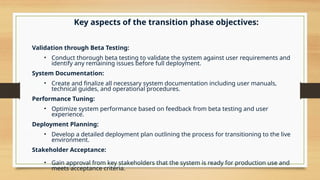
Transition planning addresses the complex activities required to move a system from controlled development into operational service. Effective transition planning prevents the common pitfall of systems that are technically complete but operationally unusable.
Deployment Logistics
Deployment logistics planning encompasses all activities required to deliver the system to its operational location. This includes:
- Physical distribution: Packaging, transportation, and handling requirements for all system elements
- Site preparation: Infrastructure modifications, equipment installation, and facility requirements
- Receiving and inspection: Procedures for verifying system condition upon delivery
- Security considerations: Handling requirements for classified or sensitive components
Installation and Activation
The installation phase transforms delivered components into an operational system. Planning must address:
- Installation procedures: Step-by-step instructions for integrating system elements
- System integration testing: Verification that installed elements function together correctly
- Activation sequences: Procedures for bringing the system to operational status
- Verification checkpoints: Milestones that confirm installation completeness
Initial Operational Capability Criteria
Initial Operational Capability (IOC) defines the minimum acceptable state for operational deployment. Your Part 12 content should establish explicit IOC criteria that answer:
- Which capabilities must be operational before IOC is declared?
- What performance levels must be demonstrated?
- What training completion rates are required?
- What support infrastructure must be in place?
Long-Term Operational Support
Sustainable operational support planning ensures continued system effectiveness throughout its service life. Key elements include:
- Maintenance planning: Scheduled and unscheduled maintenance procedures, intervals, and resources
- Spares provisioning: Inventory levels, replenishment strategies, and stockage policies
- Technical data: Maintenance manuals, spare parts catalogs, and operational procedures
- Support equipment: Special tools, test equipment, and diagnostic capabilities
4. Risk and Opportunity Management within Part 12
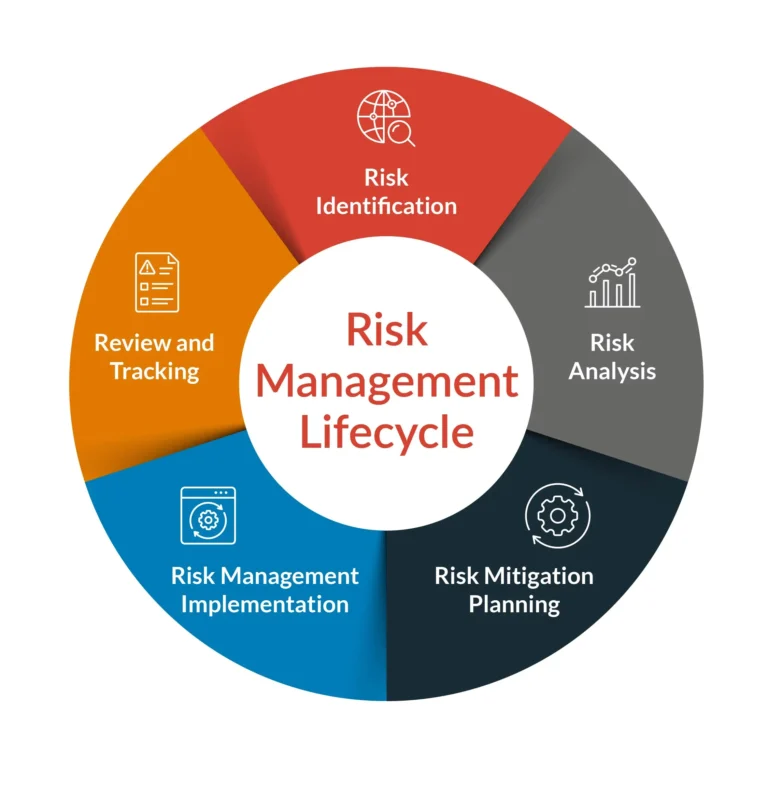
Transition activities introduce unique risks that must be identified, analyzed, and mitigated as part of the overall program risk management approach. Simultaneously, transition may reveal opportunities for enhanced capability or improved efficiency.
Transition-Specific Risk Categories
Several risk categories warrant particular attention during Part 12 planning:
- Technical risks: Unverified requirements, integration challenges, and performance shortfalls
- Schedule risks: Verification delays, logistics bottlenecks, and training timeline compression
- Resource risks: Funding shortfalls, personnel availability, and facility constraints
- Environmental risks: Site conditions, climate factors, and infrastructure limitations
Risk Quantification Approaches
Effective transition risk management often employs various quantification techniques. Common approaches documented in systems engineering literature and standards include:
- Monte Carlo analysis: Used for schedule and cost risk assessment through probabilistic simulation
- Failure Mode and Effects Analysis (FMEA): Applied for technical risk identification and prioritization
- Bayesian networks: Utilized for modeling interdependent risks and updating probability estimates as evidence accumulates
The selection of appropriate techniques should align with program complexity, available data, and decision-maker requirements.
Risk-Based Decision Gates
Transition decision gates should explicitly consider risk posture. Your Part 12 content should define:
- Risk thresholds that must be achieved before gate passage
- Contingency triggers that invoke pre-planned risk responses
- Risk acceptance authorities for identified transition risks
- Links between the SEP risk register and transition activity execution
Example: Risk-Based IOC Criterion
An IOC gate might require that all identified risks affecting operational safety must have mitigation plans in place with residual risk rated as “Low” or “Medium.” This provides a quantifiable criterion while acknowledging that some risks may remain during initial operations.
5. Configuration and Data Management Linkages
Configuration management ensures that the system definition remains consistent, auditable, and traceable throughout transition. Without rigorous configuration control, the risk of deploying incorrect or incompatible system elements increases substantially.
Configuration Items and Baselines
Part 12 planning must clearly identify:
- Configuration items (CIs) that will be transitioned, including hardware, software, and documentation
- Applicable baselines such as functional, allocated, and product baselines
- Baseline holders and their responsibilities for baseline maintenance
Change Control During Transition
Transition periods often experience increased pressure for changes. Your planning should address:
- Change authority designations for transition-specific modifications
- Expedited change procedures that maintain configuration control while enabling responsiveness
- Change impact assessment requirements during the transition phase
- Documentation updates that must accompany any approved changes
Data Management Integration
Technical data accompanies the system throughout its life-cycle. Part 12 must plan for:
- Data delivery: Technical manuals, maintenance documentation, and operational procedures
- Data format: Electronic versus paper, proprietary versus open standards
- Data rights: Delivery of source data, build data, and manufacturing data as applicable
- Data updates: Processes for maintaining currency of delivered documentation
6. Stakeholder Engagement and Communication Planning
Successful transitions depend on effective engagement with all affected parties. Part 12 must address stakeholder needs, communication requirements, and training obligations.
Key Stakeholder Identification
Transition stakeholders extend beyond the immediate operational user community:
- Operators: Personnel who will use the system to perform its intended mission
- Maintainers: Technical personnel responsible for system upkeep and repair
- Logisticians: Specialists who manage spare parts, supply chain, and support equipment
- Regulators: Authorities who must approve or certify system operation
- Senior leadership: Decision-makers who authorize transition completion
- Supporting organizations: External suppliers, contractors, and partner agencies
Stakeholder Engagement Matrix
An effective engagement matrix ties stakeholders to specific transition activities:
| Stakeholder | Engagement Activity | Timing | Responsibility |
|---|---|---|---|
| Operators | User validation testing | Post-integration | Test Lead |
| Maintainers | Maintainer training | Pre-IOC | Training Manager |
| Logisticians | Spares provisioning review | Monthly during transition | Logistics Lead |
| Regulators | Certification briefings | As required by regulation | Compliance Manager |
Communication Requirements
Part 12 should establish communication protocols including:
- Regular status reporting to program leadership
- Issue escalation procedures and thresholds
- Transition completion notification to all stakeholders
- Lessons learned capture and distribution processes
7. Metrics, KPIs, and Performance Measurement
What gets measured gets managed. Part 12 must define measurable criteria that demonstrate transition readiness and ongoing operational effectiveness.
Transition Readiness Metrics
Quantitative transition criteria provide objective basis for gate decisions:
- Verification completion rate: Percentage of verification activities successfully completed
- Requirement traceability index: Ratio of verified requirements to total requirements
- Open problem count: Number of verified discrepancies by severity category
- Documentation readiness: Percentage of required technical data delivered and approved
Operational Effectiveness KPIs
Post-transition metrics validate ongoing system performance:
- Initial Operational Capability achievement rate: Time from scheduled to actual IOC
- Mean Time Between Failures (MTBF): Reliability measure for maintained systems
- Training completion percentage: Operator and maintainer qualification rates
- Supply availability: Spare parts fill rates against provisioned levels
- User satisfaction scores: Qualitative feedback from operational personnel
Measurement Framework Integration
Part 12 metrics should integrate with the broader SEP measurement framework, feeding program-level indicators and enabling trend analysis across the system life-cycle.
8. Regulatory, Standards, and Compliance Considerations
Most systems operate within regulatory frameworks that impose specific requirements on transition activities. Part 12 must demonstrate compliance with applicable standards. The specific regulatory requirements will vary based on system domain, operational environment, and customer requirements.
Applicable Standards by Domain
Common standards affecting transition planning include:
- DO-178C (2011): Software considerations in airborne systems—defines software verification requirements for aviation. Applies to airborne software development organizations seeking FAA or equivalent certification.
- ISO 26262: Functional safety for road vehicles—specifies validation requirements for automotive systems. Relevant for automotive electronics and software transitioning to production vehicles.
- MIL-STD-1388: Logistics support analysis—establishes requirements for defense system support planning. Applicable to U.S. Department of Defense programs and contractors.
- NASA-STD-7123.1: NASA systems engineering processes—includes specific transition and operation planning guidance for NASA missions.
- IEC 61508: Functional safety of electrical/electronic/programmable electronic safety-related systems—provides framework for safety-critical system transition across industries.
- ECSS-E-ST-10: System engineering processes for European space programs, available through the European Cooperation for Space Standardization.
Compliance Documentation
Compliance evidence must be captured in audit-ready artifacts:
- Compliance matrices mapping requirements to verification evidence
- Verification closure reports documenting successful requirement verification
- Validation reports demonstrating stakeholder need satisfaction
- Independent review records from verification and validation audits
9. Technical Review Milestones and MBSE Integration
Transition success depends on proper sequencing of technical reviews and effective integration with Model-Based Systems Engineering methodologies where employed.
Key Technical Review Milestones
Several formal reviews support the Part 12 transition process:
- Production Readiness Review (PRR): Assesses manufacturing capabilities and transition readiness before production commitment
- Critical Design Review (CDR) Confirmation: Verifies that detailed design supports transition and support requirements
- Test Readiness Review (TRR): Confirms verification test preparation including facilities, procedures, and personnel
- Operational Readiness Review (ORR): Validates IOC criteria have been met and operational support is in place
MBSE Integration Points
For programs employing Model-Based Systems Engineering, Part 12 should address integration points including:
- Simulation-based validation: Using system models to exercise operational scenarios before physical validation
- Automated traceability: Leveraging MBSE tools (such as those available in SysML-based environments) to maintain requirement-to-verification traceability
- Digital twin representations: Creating operational system models that support maintenance and support planning
- Configuration management integration: Managing model baselines alongside physical system baselines
10. Template Walkthrough, Common Pitfalls, and Best Practices
Template Structure Overview
A comprehensive Part 12 template should include the following sections:
- Section 12.1: Purpose, scope, and applicability
- Section 12.2: Verification planning and procedures
- Section 12.3: Validation planning and procedures
- Section 12.4: Transition strategy and schedule
- Section 12.5: Operational support planning
- Section 12.6: Risk management integration
- Section 12.7: Configuration management integration
- Section 12.8: Stakeholder engagement plan
- Section 12.9: Metrics and success criteria
- Section 12.10: References and applicable documents
Common Pitfalls to Avoid
- Vague transition criteria: Criteria like “system ready for operations” without measurable thresholds
- Missing risk quantification: Listing