In this guide
Systems Engineering Plan: A Practitioner’s Guide
Executive Summary
A systems engineering plan (SEP) defines how technical processes will be executed to achieve project objectives. This guide covers SEP document structure, governing standards including ISO/IEC/IEEE 15288 and EIA/ANSI 632, core sections for requirements management, configuration control, risk management and verification, and practical tailoring approaches for projects of varying complexity. Key takeaways include: matching SEP depth to project scale, maintaining agility within structured frameworks, and treating the SEP as a living document that evolves with technical progress. Whether developing defense systems, medical devices, or enterprise software, this practitioner’s guide provides the framework for creating or refining your SEP to fit actual project needs.
Table of Contents
- What is a Systems Engineering Plan?
- Governing Standards and Frameworks
- Core Sections of a SEP Document
- Integrating the SEP with Project Documents
- Tailoring the SEP for Project Scope
- Adapting for Agile Environments
- Common Pitfalls and How to Avoid Them
- Review Cycles and Baseline Management
- Glossary of Key Terms
- Frequently Asked Questions
What is a Systems Engineering Plan?
In the world of complex engineering projects—whether developing autonomous vehicles, defense systems, medical devices, or enterprise software—success hinges on more than technical expertise alone. It requires deliberate planning that addresses how technical work will be conducted, who will be involved, what artifacts will be produced, and how decisions will be made when requirements change or risks emerge. This is the fundamental purpose of a systems engineering plan (SEP).
Yet practitioners frequently find themselves caught in a tension: contractual obligations demand comprehensive documentation, while project realities demand agility and responsiveness. A poorly conceived SEP becomes a bureaucratic burden that no one reads. A well-crafted SEP, however, serves as a living blueprint that guides technical execution without constraining it.
A systems engineering plan is the foundational systems engineering documentation that describes how the systems engineering processes will be applied to achieve project objectives. Unlike a generic project plan that focuses on schedules, budgets, and resources, the SEP specifically addresses technical rigor: how requirements will be captured and managed, how design decisions will be made, how interfaces will be controlled, and how stakeholders will be engaged throughout the technical lifecycle.
Why the SEP Matters
The significance of the SEP extends beyond internal project management. In defense, aerospace, and government contracting contexts, the SEP often carries contractual weight. Customers review it during source selection to evaluate a contractor’s technical approach. Program offices reference it when conducting oversight reviews. Regulatory bodies may examine it during certification processes. An inadequate SEP can disqualify a proposal; an outdated or inaccurate one can create compliance issues throughout contract execution.
Consider a scenario: a defense contractor wins a contract to develop radar systems for naval vessels. The customer RFP explicitly requires a SEP that addresses hardware-software integration, electromagnetic compatibility testing, and long-term maintenance planning. The contractor submits a generic SEP template with minimal tailoring. During the preliminary design review, the customer questions how the contractor will manage interface control between the new radar and existing shipboard systems. Because this wasn’t adequately addressed in the SEP, the customer loses confidence in the contractor’s technical maturity. This illustrative example demonstrates how inadequate requirements management and interface control can undermine stakeholder confidence.
The SEP serves as the bridge between stakeholder needs and technical solutions. It establishes the “how” behind the systems engineering effort, ensuring that the right processes are applied at the right time with appropriate rigor. When executed well, the SEP aligns the technical team, satisfies contractual requirements, and provides a reference point for assessing progress and managing change.
Governing Standards and Frameworks
While the SEP is tailored to each project, it operates within a landscape of established standards and frameworks that define expectations and best practices. Understanding these sources helps you make informed tailoring decisions rather than treating all requirements as equally mandatory.
Standards Comparison
| Standard | Focus | Key Application | Version Reference |
|---|---|---|---|
| ISO/IEC/IEEE 15288 | System life cycle processes | International defense, aerospace, complex systems | 2015 current edition |
| EIA/ANSI 632 | Engineering a system | Acquisition and supply chain contexts | Reaffirmed 2019 |
| INCOSE SE Handbook | Practical SE guidance | Practitioner reference, training | v4 (2015) and v5 (2020) |
| NASA SE Handbook | Space systems development | NASA programs, government space | NASA SP-2016-6105 |
| ISO/IEC/IEEE 12207 | Software life cycle processes | Software-intensive systems | 2017 current edition |
| CMMI | Process improvement | Organizational maturity assessment | v2.0 (2018) |
| ARP4754A | Aircraft systems development | Aerospace certification | DO-178C companion |
| AS9100 | Quality management aerospace | Aerospace supply chain | Rev D (2016) |
ISO/IEC/IEEE 15288
The international standard ISO/IEC/IEEE 15288, titled “Systems and Software Engineering—System Life Cycle Processes,” provides the foundational vocabulary and process framework for systems engineering. The standard defines six life cycle stages:
- Concept – Stakeholder needs, concept exploration, and proposal definition
- Development – System definition, design, and build
- Production – Manufacturing, assembly, and integration
- Utilization – Operations, training, and user support
- Support – Maintenance, logistics, and sustainment
- Disposal – Retirement, decommissioning, and disposal activities
Process areas include stakeholder needs and requirements definition, system requirements definition, architecture definition, design definition, system integration, verification, validation, operation, maintenance, and disposal. The standard explicitly acknowledges that organizations must select and tailor processes appropriate to their projects—this flexibility is a core feature, not an oversight. Refer to the ISO 15288 product page for current edition details.
EIA/ANSI 632
EIA/ANSI 632, “Processes for Engineering a System,” provides a process-based approach to systems engineering with particular emphasis on acquisition and supply. It identifies fundamental processes including agreement processes, organizational project-enabling processes, technical management processes, and technical processes. This standard is particularly relevant for defense and aerospace programs where prime contractors and subcontractors must coordinate engineering activities.
INCOSE Systems Engineering Handbook
The INCOSE Systems Engineering Handbook (versions 4 and 5) serves as the practical guide to applying systems engineering concepts. Written by practitioners for practitioners, it translates standards into actionable guidance. The handbook emphasizes that systems engineering is a holistic discipline requiring integration of multiple technical specialties. It provides extensive guidance on tailoring, noting that the extent of systems engineering application should match project characteristics. The INCOSE SE Handbook is an essential practitioner reference.
NASA Systems Engineering Handbook
The NASA Systems Engineering Handbook (NASA SP-2016-6105, revised 2020) offers detailed guidance developed through decades of space systems development. It addresses NASA-specific requirements while providing universally applicable insights on life cycle management, technical assessment, and risk management. NASA distinguishes between “system” and “program” perspectives, recognizing that technical and programmatic planning must be integrated.
Additional Reference Documents
Several other standards and references may inform SEP development depending on your context:
- IEEE 829 – Test documentation standard relevant for verification and validation sections
- SEBoK – Systems Engineering Body of Knowledge provides comprehensive reference material
- DOORS – IBM Engineering Requirements Management DOORS tool for requirements traceability
- JAMA – Requirements management platform alternative to DOORS
- Confluence – Documentation platform commonly used for SEP development and maintenance
These standards share a common thread: they provide frameworks rather than prescriptions. They define what systems engineering encompasses and suggest how it might be applied, but they explicitly defer to project context for determining how much process is appropriate. Your SEP should reflect thoughtful application of these frameworks to your specific situation.
Core Sections of a Systems Engineering Plan
While tailoring determines emphasis and detail level, most comprehensive SEPs address a common set of topics. Understanding the purpose of each section helps you decide what to include based on your project’s needs.
[Visual: Flowchart showing SEP sections connected to project success: Technical Planning → Requirements Management → Configuration Management → Risk Management → Interface Management → Verification & Validation → Technical Assessment → Life Cycle Model]
Section 1: Technical Planning
This section establishes the overall approach to technical execution. It describes:
- The technical lifecycle model selected (waterfall, iterative, agile, or hybrid)
- Major milestones and decision gates
- The technical team structure and responsibilities
- How technical planning integrates with program management
This section answers the question: “How will we organize and execute the technical work?”
Section 2: Requirements Management
Requirements management addresses how stakeholder needs will be translated into system requirements and how those requirements will be managed throughout the project. Key elements include:
- The requirements hierarchy (from stakeholder needs through system requirements to lower-level requirements)
- Traceability approach
- Change control procedures
- Tools or databases to be used (such as DOORS or JAMA)
Strong requirements management prevents scope creep, enables impact analysis for changes, and supports verification planning. The requirements management discipline is fundamental to SEP success.
Section 3: Configuration Management
Configuration management ensures that the project’s technical outputs are identified, controlled, and tracked. The SEP should address:
- Which items will be placed under configuration control
- How baselines will be established and maintained
- Change control procedures
- How configuration status accounting will be performed
Without effective configuration management, teams struggle with “which version are we building?” questions that erode confidence and productivity. For regulated industries, configuration management is typically addressed in detail through a separate Configuration Management Plan.
Section 4: Risk Management
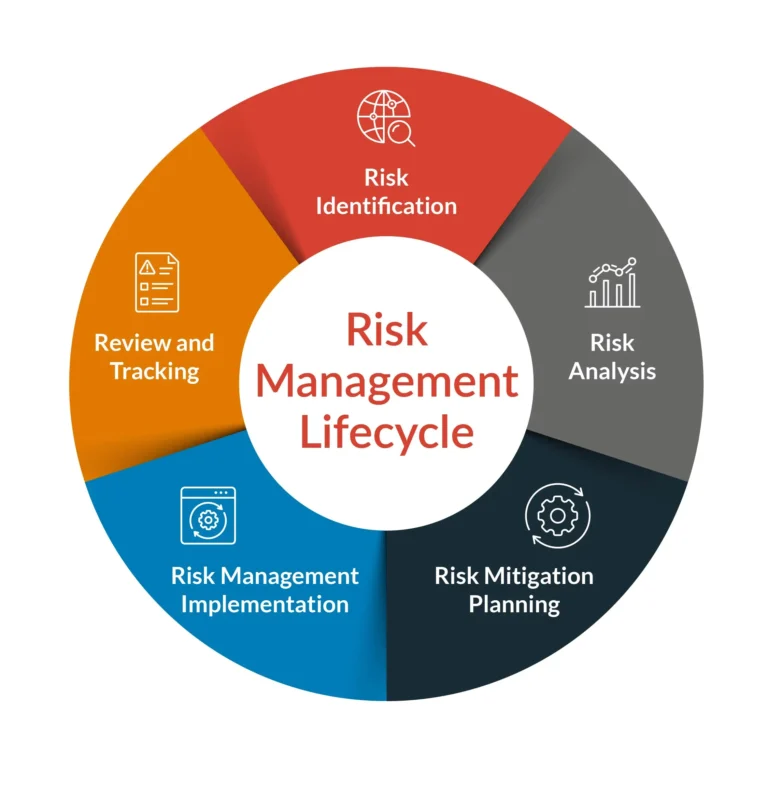
Technical risk management identifies, analyzes, and mitigates risks that could affect system performance, cost, or schedule. The SEP should reference the broader risk management plan while emphasizing technical risks:
- Performance risks
- Interface risks
- Technology maturity risks
- Integration risks
It should describe the risk management activities specific to systems engineering and how technical risks are communicated to program management. See our risk management guide for detailed approaches.
Section 5: Interface Management
For systems involving multiple subsystems or external interfaces, interface management is critical. This section addresses how interfaces will be identified, documented, controlled, and verified. Interface management is particularly important in complex systems where a single missed interface requirement can cause integration failures. The SEP should describe the interface control documents (ICDs) to be produced and the process for managing interface changes.
Section 6: Verification and Validation
Verification confirms that a product meets specified requirements; validation confirms that the system addresses stakeholder needs. This section describes:
- The verification and validation approach (inspection, analysis, demonstration, test)
- How verification methods map to requirements
- Key test events and milestones
For regulated industries, this section often receives intense scrutiny during compliance reviews. IEEE 829 provides the standard framework for test documentation.
Section 7: Technical Assessment Processes
Technical assessment provides visibility into project health and progress. The SEP should describe:
- How technical performance will be measured
- What technical reviews will be conducted
- How decision criteria will be defined
- How assessment findings will be tracked to closure
Common reviews include System Requirements Review (SRR), Preliminary Design Review (PDR), Critical Design Review (CDR), Test Readiness Review (TRR), and System Acceptance Review (SAR).
Section 8: Life Cycle Model Selection
Different projects benefit from different life cycle approaches. The SEP should justify the selected model and describe how systems engineering processes will be applied within that model. This section often receives renewed attention when projects transition to agile or iterative approaches, as it requires explicitly addressing how traditional SE rigor will be preserved in shorter iteration cycles.
Life Cycle Model Decision Matrix
| Model Type | Best For | SE Rigor Adaptation |
|---|---|---|
| Waterfall | Highly regulated, sequential processes, stable requirements | Traditional SE gates apply |
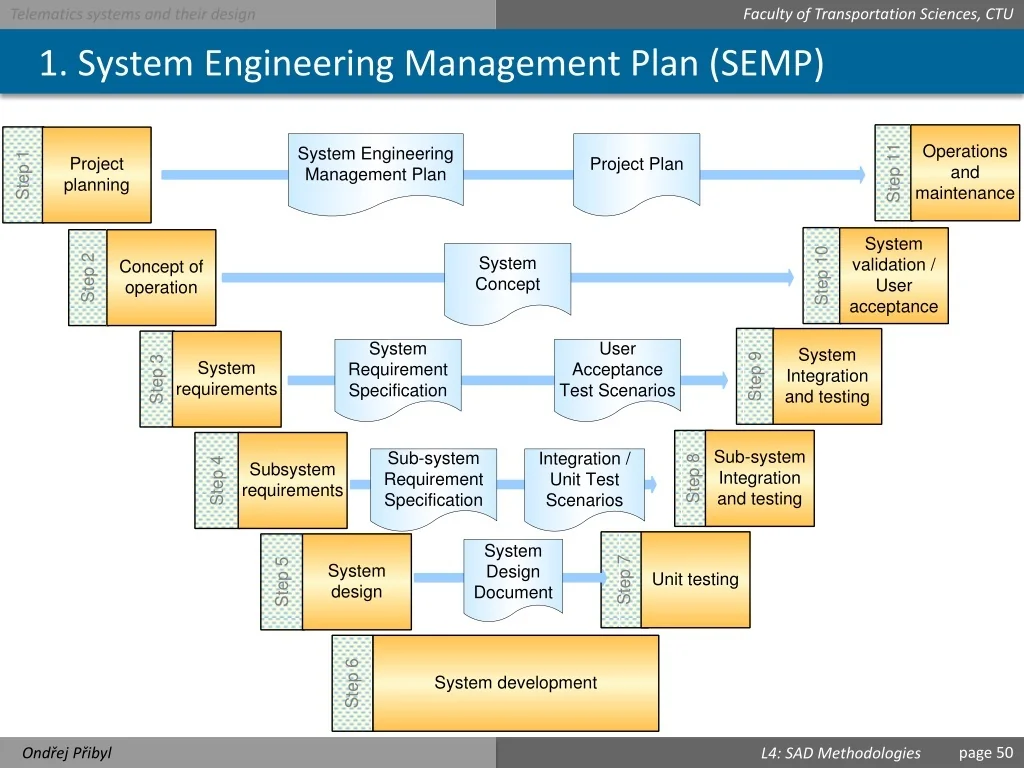
| V-Model | Hardware-intensive systems, verification emphasis | Left-side planning, right-side validation alignment |
| Incremental | Long-duration programs needing staged delivery | Phase-gate SE reviews at each increment |
| Agile/Iterative | Software-heavy, evolving requirements, fast feedback | Scaled SE practices, continuous integration |
| Hybrid | Complex systems requiring both rigor and agility | Systems-level rigor, component-level agility |
Integrating the SEP with Other Project Documents
The systems engineering plan does not exist in isolation. It is one component of an integrated project documentation suite, and maintaining coherence across documents is essential for both efficiency and credibility.
Relationship to the Project Management Plan
The Project Management Plan (PMP) addresses how the project will be executed, monitored, and controlled from a programmatic perspective. The SEP provides the technical counterpart. While the PMP addresses schedule, cost, and resource management, the SEP addresses technical rigor and technical risk. These documents should cross-reference each other:
- The PMP notes that technical planning is addressed in the SEP
- The SEP acknowledges programmatic constraints and timelines defined in the PMP
Work Breakdown Structure Integration
The Work Breakdown Structure (WBS) organizes project deliverables in a hierarchical structure. The SEP should align with the WBS, particularly for systems engineering work products. If the WBS defines a subsystem for testing, the SEP should address how testing activities will be planned and executed for that subsystem. Disconnects between the SEP and WBS create confusion about scope and responsibility.
Connection to Supporting Plans
The SEP typically references or summarizes content from supporting technical plans:
- Risk Management Plan – Detailed risk identification and mitigation procedures
- Configuration Management Plan – Detailed baselining and change control procedures
- Data Management Plan – Engineering data handling and control
- Quality Assurance Plan – Quality verification and audit procedures
Rather than duplicating content, the SEP should point to these plans for detailed procedures while explaining how these functions support the overall technical approach.
For example, a project might have a standalone Configuration Management Plan that provides detailed procedures for baselining, change control, and status accounting. The SEP references this plan and explains how configuration management supports the technical approach—for instance, by ensuring that design documentation matches as-built hardware, or by enabling traceability from requirements to verification evidence.
Regulatory and Contractual Context
For government contracts, the SEP must satisfy FAR/DFARS requirements and customer RFP specifications. Key considerations include:
- Contract Data Requirements List (CDRL) items specifying required deliverables
- Customer-mandated review gates and reporting
- Compliance with program-unique instructions (e.g., NASA NPR 7123.1)
Tailoring the SEP for Project Scope and Complexity
The most critical skill in SEP development is tailoring: applying the right level of rigor and detail to match your project’s actual needs. An SEP that is over-engineered for a simple project creates bureaucratic burden; an SEP that is under-engineered for a complex project creates compliance and execution risks.
[Visual: Decision tree showing tailoring factors: Project Scope → Technical Complexity → Regulatory Environment → Team Size → Duration → Appropriate SEP Depth]
Decision Framework for Small Projects
Small projects—characterized by limited scope, low technical risk, small teams, and short durations—benefit from simplified SEPs. Consider a small software development effort for an internal tool: three developers, six-month timeline, limited regulatory oversight. For such projects, a condensed SEP might include:
- A brief technical planning section describing an agile approach with two-week sprints
- Requirements management addressed through a product backlog with user stories
- Configuration management through standard version control practices (e.g., Git)
- Risk management integrated into sprint planning
- Verification through continuous integration and user acceptance testing
The goal is to document the approach sufficiently for stakeholder alignment without creating documentation that exceeds the project’s value. In practice, small project SEPs often range from three to seven pages.
Decision Framework for Medium Projects
Medium projects—moderate scope, some technical complexity, multi-disciplinary teams, moderate regulatory requirements—require more structured SEPs. Consider a commercial product development effort with hardware and software components, third-party suppliers, and customer acceptance testing. For such projects, the SEP should address all core sections with moderate detail:
- Defined life cycle model with clear phases and milestones
- Formal requirements traceability linking stakeholder needs to system specifications
- Configuration management with controlled baselines and change control boards
- Technical risk management with documented risk registers and mitigation strategies
- Interface management for hardware-software and subsystem interfaces
- Verification and validation planning with mapped test events
- Technical reviews at appropriate gates (PDR, CDR, TRR)
Medium project SEPs often range from fifteen to thirty pages, sufficient to guide execution and satisfy customer expectations. Projects using tools like JIRA and Confluence can maintain traceability across planning and execution.
Decision Framework for Large and Complex Projects
Large projects—high consequence, complex interfaces, multiple organizations, stringent regulatory requirements—demand comprehensive SEPs. Consider defense acquisition programs, aerospace systems, or medical devices requiring FDA approval. For such projects, the SEP must address all sections with substantial detail:
- Multi-tiered technical planning coordinating numerous subsystems and organizations
- Comprehensive requirements management with formal traceability across levels
- Robust configuration management with multiple baselines and formal change control
- Proactive risk management with risk review boards and risk mitigation plans
- Extensive interface management with interface control documents for all external and internal interfaces
- Detailed verification and validation planning including analysis, simulation, integration testing, and qualification testing
- Technical assessment processes with formal reviews and independent assessment teams
- Tailored life cycle model appropriate to the acquisition context
Large project SEPs often span forty to one hundred pages or more, with supporting technical plans providing additional detail. The investment in planning pays dividends through reduced rework, clearer communication, and defensible evidence of rigor.
SEP Template Summary
| Section | Small Project | Medium Project | Large Project |
|---|---|---|---|
| Technical Planning | Brief overview | Defined model, milestones | Multi-tiered coordination |
| Requirements Management | Backlog approach | Formal traceability | Comprehensive hierarchy |
| Configuration Management | Version control | Controlled baselines | Formal CCB, multiple baselines |
| Risk Management | Integrated in planning | Documented register | Risk review boards |
| Interface Management | Minimal detail | Key interfaces defined | Full ICD coverage |
| Verification & Validation | CI/testing | Mapped test events | Full V&V planning |
| Technical Assessment | Informal reviews | Formal gates | Independent assessment |
Note: Page count guidance represents practitioner experience rather than standard mandates. Actual SEP length should match project needs.
Adapting Systems Engineering Planning for Agile Environments
The rise of agile methodologies has created both opportunities and challenges for systems engineering planning. Agile promises faster delivery, better responsiveness to change, and higher team engagement. Systems engineering provides rigor, traceability, and compliance evidence. Combining them effectively requires thoughtful adaptation.
Preserving Systems Engineering Rigor in Agile Contexts
Systems engineering rigor is not inherently incompatible with agile approaches. The key is identifying which SE rigor elements are essential and ensuring they are maintained through iterative delivery. Essential elements include:
Requirements Traceability
In agile contexts, user stories in the product backlog should link to higher-level requirements or stakeholder needs. While detailed specification documents may be condensed, traceability ensures that delivered functionality satisfies stakeholder requirements. Tools like JIRA with custom linking can maintain this traceability while supporting agile workflows.
Interface Definition
Even in agile development, interfaces between subsystems and external systems must be defined before integration can succeed. Interface control documents can be living documents updated as interfaces evolve, but they should exist and be maintained. This is particularly critical for hardware-software integration scenarios.
Verification Evidence
Test results, inspection records, and analysis documentation must be captured regardless of development methodology. Continuous integration and automated testing support this requirement while providing traceability from requirements to test results. For regulated environments, verification evidence must be retained and organized for audit.
INCOSE Guidance on Agile Adaptation
INCOSE has published guidance on applying agile approaches in systems engineering contexts. The key insight is that “agile” and “systems engineering” operate at different levels. Agile is primarily a software development approach; systems engineering addresses the broader discipline of technical management and cross-disciplinary integration. A team can apply agile methods for software development while maintaining systems engineering rigor for the overall technical effort.
Practical Example: Agile Systems Engineering
Consider a medical device company developing an insulin pump system. The regulatory environment (FDA 21 CFR Part 820) demands substantial documentation, but the software team wants to adopt agile practices. A practical approach:
- The SEP establishes systems engineering rigor at the system level: requirements flow-down, risk management, verification planning, and human factors engineering
- Within sprints, the software team applies agile methods: product backlog, sprint planning, daily stand-ups, retrospectives
- Systems engineering artifacts are maintained: requirements traceability matrix linking user stories to system requirements; verification evidence captured through automated testing; risk registers updated each sprint
- Technical reviews are adapted: rather than a single design review, incremental design reviews occur at appropriate milestones, with sprint reviews providing informal feedback
This approach preserves regulatory compliance while gaining agile benefits. The SEP explicitly describes how systems engineering rigor is maintained within the agile framework.
Common Pitfalls and How to Avoid Them
Experience across the systems engineering community reveals recurring challenges in SEP development and execution. Anticipating these pitfalls helps you avoid them.
Pitfall 1: Over-Documentation
Perhaps the most common pitfall is creating SEPs that are too comprehensive for project needs. Over-documentation wastes resources, creates maintenance burdens, and often signals that the document is written for compliance rather than use. Practitioners stop reading overly detailed SEPs, defeating the document’s purpose.
Mitigation: Right-size your SEP from the start. Apply the tailoring framework described above. Ask whether each section adds value for your specific project. If a section will sit unread, consider condensing or eliminating it. Remember that the SEP should enable success, not demonstrate compliance theater.
Pitfall 2: Outdated Plans
An SEP that does not reflect current project reality is worse than no SEP at all. It creates false confidence and misleads stakeholders about the project’s technical approach.
Mitigation: Establish a disciplined approach to SEP maintenance. Define trigger events that require SEP updates (significant scope changes, lifecycle model transitions, organizational changes). Schedule regular reviews even without trigger events. Treat the SEP as a living document that evolves with the project.
Pitfall 3: Insufficient Stakeholder Alignment
The SEP represents a commitment to a technical approach. If key stakeholders—customers, program management, technical leads—are not aligned on the SEP’s content, implementation will face friction.
Mitigation: Involve stakeholders in SEP development, not just SEP review. Walk through the SEP with technical leads before formalizing it. Present the SEP to customer representatives and solicit their input. Document stakeholder agreement through signatures or formal review records.
Pitfall 4: Integration Failures with Other Documents
When the SEP contradicts the PMP, WBS, or supporting plans, project execution suffers. Teams receive inconsistent direction; compliance evidence may not align with plan commitments.
Mitigation: Cross-check your SEP against other project documents before finalization. Verify that schedules align, that scope definitions are consistent, and that terminology matches. Establish a single source of truth for cross-document references.
Pitfall 5: Skills Gaps
Even a well-crafted SEP cannot execute if the team lacks systems engineering skills. Requirements management, risk analysis, interface definition, and technical assessment all require competencies that may not exist in all organizations.
Mitigation: Assess team capabilities against SEP commitments. If gaps exist, address them through training, hiring, or external support. Do not commit to processes in the SEP that the team cannot execute. Alternatively, simplify the SEP to match existing capabilities.
Review Cycles and Baseline Management
Effective SEP management requires disciplined review cycles and controlled baselines. This ensures the SEP remains current while maintaining the configuration control necessary for compliance and coordination.
When to Update the SEP
The SEP should be updated when significant changes occur that affect the technical approach. Common trigger events include:
- Lifecycle model transitions (e.g., moving from development to production)
- Major scope changes affecting system architecture or requirements
- Organizational changes affecting technical responsibilities
- Customer-driven changes to technical expectations
- Risk reassessment resulting in significantly changed approach
Avoid reactive updating that creates document churn. Minor changes may be logged and incorporated at the next scheduled review rather than triggering immediate updates.
Baseline Management Approach
The SEP itself may be placed under configuration control, particularly on programs with formal configuration management requirements. When the SEP is baselined:
- Changes require formal change control through the change control board
- Previous versions are retained for historical reference
- Current baseline is clearly identified and communicated
- Deviations from baseline require